Ch. 13 - Alcohols, Ethers and Related Compounds: Substitution and Elimination
Mullins - Organic Chemistry: A Learner Centered Approach 1st Edition
Mullins1st EditionOrganic Chemistry: A Learner Centered ApproachISBN: 9780137566471Not the one you use?Change textbook
Chapter 12, Problem 103

In contrast to Assessment 13.102, only one combination of haloalkane and alkoxide can be used in the Williamson ether synthesis to make the ether shown. Identify the combination and explain why it is the only combination that works.

Verified step by step guidance
1
Identify the ether product: The ether shown is isopropyl phenyl ether, which consists of an isopropyl group and a phenyl group connected by an oxygen atom.
Understand the Williamson ether synthesis: This reaction involves the reaction of an alkoxide ion with a haloalkane to form an ether. The alkoxide ion acts as a nucleophile, attacking the electrophilic carbon in the haloalkane.
Determine the possible alkoxide: The alkoxide must correspond to the part of the ether that is less hindered. In this case, the phenoxide ion (C6H5O-) is less hindered compared to the isopropyl group.
Select the appropriate haloalkane: The haloalkane should be the more hindered part of the ether, which is the isopropyl group. Therefore, the haloalkane should be isopropyl bromide (or chloride).
Explain why this combination works: The phenoxide ion is a strong nucleophile and can effectively attack the less hindered primary carbon in isopropyl bromide, leading to the formation of isopropyl phenyl ether. Other combinations would lead to steric hindrance or less favorable reactions.

Verified video answer for a similar problem:

This video solution was recommended by our tutors as helpful for the problem above.
Video duration:
4m
Was this helpful?

Key Concepts

Here are the essential concepts you must grasp in order to answer the question correctly.

Williamson Ether Synthesis

The Williamson ether synthesis is a method for creating ethers by reacting an alkoxide ion with a haloalkane. This reaction typically involves a nucleophilic substitution mechanism, where the alkoxide acts as a nucleophile and attacks the electrophilic carbon in the haloalkane, displacing the halide ion. The choice of haloalkane and alkoxide is crucial, as steric hindrance and the nature of the leaving group can significantly affect the reaction's success.
Recommended video:
Guided course
03:50
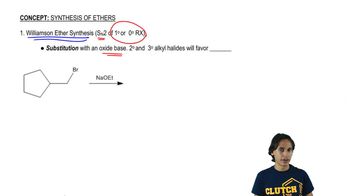
The Mechanism of Williamson Ether Synthesis.

Nucleophilicity and Electrophilicity

Nucleophilicity refers to the ability of a species to donate an electron pair to form a chemical bond, while electrophilicity is the ability of a species to accept an electron pair. In the context of the Williamson ether synthesis, the alkoxide is a strong nucleophile due to its negative charge, and the haloalkane must be a suitable electrophile, typically a primary or methyl halide, to facilitate the reaction without steric hindrance that would impede nucleophilic attack.
Recommended video:
Guided course
03:
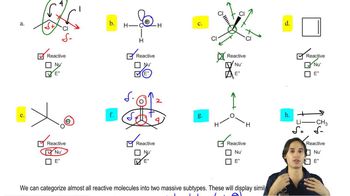
Nucleophile or Electrophile

Steric Hindrance

Steric hindrance is the prevention of chemical reactions due to the spatial arrangement of atoms within a molecule. In the Williamson ether synthesis, using a bulky haloalkane can hinder the approach of the nucleophile, making the reaction less favorable or impossible. Therefore, the selection of a primary haloalkane is often necessary to ensure that steric factors do not obstruct the nucleophilic attack by the alkoxide.
Recommended video:
Guided course
02:53
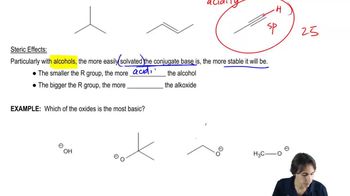
Understanding steric effects.