Ch. 13 - Alcohols, Ethers and Related Compounds: Substitution and Elimination
Mullins - Organic Chemistry: A Learner Centered Approach 1st Edition
Mullins1st EditionOrganic Chemistry: A Learner Centered ApproachISBN: 9780137566471Not the one you use?Change textbook
Chapter 12, Problem 59c

Predict the product of the following oxidation reactions.
(c)

Verified step by step guidance
1
Identify the functional group present in the starting material. Common functional groups that undergo oxidation include alcohols, aldehydes, and ketones.
Determine the oxidizing agent used in the reaction. Common oxidizing agents include potassium permanganate (KMnO₄), chromium trioxide (CrO₃), and pyridinium chlorochromate (PCC). Each agent has specific reactivity and selectivity.
Consider the type of oxidation reaction. For example, primary alcohols can be oxidized to aldehydes or further to carboxylic acids, while secondary alcohols are typically oxidized to ketones.
Apply the mechanism of oxidation to the functional group. For alcohols, this often involves the removal of hydrogen atoms and the formation of a carbonyl group.
Predict the final product based on the functional group transformation and the specific oxidizing agent used. Ensure to consider any possible over-oxidation or side reactions that might occur.

Verified video answer for a similar problem:

This video solution was recommended by our tutors as helpful for the problem above.
Was this helpful?

Key Concepts

Here are the essential concepts you must grasp in order to answer the question correctly.

Oxidation Reactions

Oxidation reactions involve the loss of electrons or an increase in oxidation state by a molecule, atom, or ion. In organic chemistry, these reactions often involve the addition of oxygen or the removal of hydrogen. Understanding the specific type of oxidation, such as whether it is a mild or strong oxidation, is crucial for predicting the products formed.
Recommended video:
Guided course
03:20
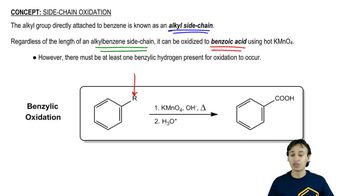
Benzylic Oxidation

Functional Groups

Functional groups are specific groups of atoms within molecules that are responsible for the characteristic chemical reactions of those molecules. Identifying the functional groups present in the reactants is essential for predicting the outcome of oxidation reactions, as different groups react differently under oxidative conditions.
Recommended video:
Guided course
02:36
Identifying Functional Groups

Reaction Mechanisms

Reaction mechanisms describe the step-by-step process by which reactants are converted into products. Understanding the mechanism of oxidation reactions helps in predicting the products formed, as it provides insight into the intermediates and transition states involved. This knowledge is vital for anticipating how different substrates will behave under oxidative conditions.
Recommended video:
Guided course
02:16
Heck Reaction Mechanism