Identify two different alcohols that can be dehydrated (one with rearrangement) to form the alkene shown.
Ch. 13 - Alcohols, Ethers and Related Compounds: Substitution and Elimination

Mullins1st EditionOrganic Chemistry: A Learner Centered ApproachISBN: 9780137566471Not the one you use?Change textbook
All textbooks
Mullins 1st Edition
Ch. 13 - Alcohols, Ethers and Related Compounds: Substitution and Elimination
Problem 46b
Mullins 1st Edition
Ch. 13 - Alcohols, Ethers and Related Compounds: Substitution and Elimination
Problem 46bChapter 12, Problem 46b
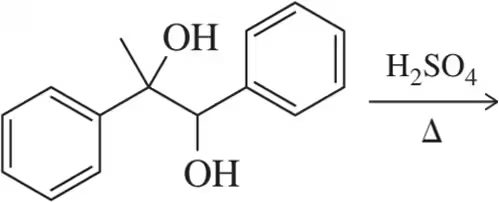
Predict the product of the following pinacol rearrangements.
(b) 
Verified step by step guidance1
Step 1: Understand the pinacol rearrangement mechanism. Pinacol rearrangement is an acid-catalyzed reaction where a 1,2-diol (vicinal diol) undergoes dehydration to form a ketone or aldehyde. The reaction involves carbocation formation and rearrangement.
Step 2: Identify the structure of the starting material. In this case, the compound is a pinacol (a 1,2-diol). Locate the hydroxyl groups (-OH) attached to adjacent carbon atoms in the molecule.
Step 3: Protonate one of the hydroxyl groups using the acid catalyst. This step converts the hydroxyl group into a better leaving group, forming water (H₂O). The protonated hydroxyl group will leave, generating a carbocation at the carbon atom where the hydroxyl group was attached.
Step 4: Analyze the stability of the carbocation. Carbocation rearrangement occurs to form the most stable carbocation. This often involves a hydride shift or alkyl group migration from an adjacent carbon atom to stabilize the positive charge.
Step 5: After the rearrangement, the carbocation reacts with water or loses a proton to form the final product, which is typically a ketone or aldehyde. The product structure depends on the specific arrangement of the starting material and the rearrangement pathway.

Verified video answer for a similar problem:
This video solution was recommended by our tutors as helpful for the problem above.
Video duration:
7mWas this helpful?
Key Concepts
Here are the essential concepts you must grasp in order to answer the question correctly.
Pinacol Rearrangement
The pinacol rearrangement is a chemical reaction involving the conversion of a pinacol (a 1,2-diol) into a ketone or aldehyde through a series of steps that include dehydration and rearrangement. This reaction typically occurs under acidic conditions, where the hydroxyl group is protonated, leading to the formation of a carbocation that can rearrange to form a more stable product.
Recommended video:
Guided course
Definition of Claisen Rearrangement
Carbocation Stability
Carbocations are positively charged carbon species that play a crucial role in many organic reactions, including rearrangements. The stability of a carbocation is influenced by its degree (primary, secondary, tertiary) and the presence of electron-donating groups. More stable carbocations are favored during rearrangements, guiding the formation of the final product in reactions like the pinacol rearrangement.
Recommended video:
Guided course
Determining Carbocation Stability
Dehydration Reaction
Dehydration reactions involve the removal of a water molecule from a compound, often leading to the formation of double bonds or new functional groups. In the context of the pinacol rearrangement, dehydration occurs after the formation of a carbocation, resulting in the loss of a water molecule and the generation of a carbonyl compound, which is the final product of the rearrangement.
Recommended video:
Guided course
General Reaction of Dehydration with POCl3
Related Practice
Textbook Question
1302
views
Textbook Question
Show a reaction coordinate diagram for the two processes in Figure 13.41 that rationalizes pathway B as the one that gives the major product.
<IMAGE>
1179
views
Textbook Question
Suggest an alkene that, in two steps, could be converted into each of the following ketones. Each sequence should involve a pinacol rearrangement.
(c)
868
views
Textbook Question
The intermediates for the Swern oxidation, a reaction introduced in Section 13.9.4, are shown. Provide the arrow-pushing mechanism that rationalizes the formation of each intermediate and the final product(s).
722
views
Textbook Question
Predict the product of the following pinacol rearrangements.
(c)
1232
views
Textbook Question
Identify two different alcohols that can be dehydrated (one without rearrangement) to form the alkene shown.
1318
views