Ch. 13 - Alcohols, Ethers and Related Compounds: Substitution and Elimination
Mullins - Organic Chemistry: A Learner Centered Approach 1st Edition
Mullins1st EditionOrganic Chemistry: A Learner Centered ApproachISBN: 9780137566471Not the one you use?Change textbook
Chapter 12, Problem 66a

Predict the product of the following reactions. [Two of them are Williamson ether syntheses. Why isn't the other?].
(a)

Verified step by step guidance
1
Identify the starting materials: The reaction involves benzyl alcohol and bromobenzene.
Recognize the role of sodium (Na^0): Sodium metal is used to deprotonate the alcohol, forming a phenoxide ion.
Understand the Williamson ether synthesis: This reaction involves the formation of an ether by reacting an alkoxide ion with a primary alkyl halide.
Analyze the reaction conditions: The phenoxide ion will act as a nucleophile and attack the electrophilic carbon in the bromobenzene, leading to the formation of an ether.
Consider why this is a Williamson ether synthesis: The reaction involves the formation of an ether from an alkoxide ion and an alkyl halide, which is characteristic of Williamson ether synthesis.

Verified video answer for a similar problem:

This video solution was recommended by our tutors as helpful for the problem above.
Was this helpful?

Key Concepts

Here are the essential concepts you must grasp in order to answer the question correctly.

Williamson Ether Synthesis

Williamson ether synthesis is a method for creating ethers through the reaction of an alkoxide ion with a primary alkyl halide. This reaction typically involves an SN2 mechanism, where the nucleophile (alkoxide) attacks the electrophilic carbon of the alkyl halide, resulting in the formation of an ether. The reaction is favored with primary halides to avoid steric hindrance and elimination reactions.
Recommended video:
Guided course
03:50
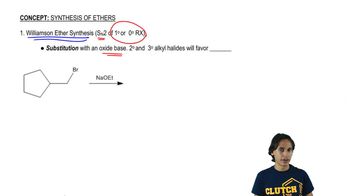
The Mechanism of Williamson Ether Synthesis.

SN2 Mechanism

The SN2 mechanism is a type of nucleophilic substitution reaction characterized by a single concerted step where the nucleophile attacks the electrophile, leading to the displacement of a leaving group. This bimolecular reaction results in the inversion of configuration at the carbon center. It is most effective with primary substrates due to less steric hindrance, making it crucial for understanding Williamson ether synthesis.
Recommended video:
Guided course
08:33
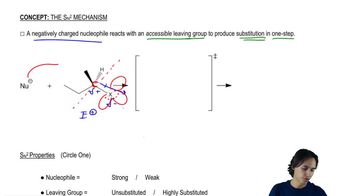
Drawing the SN2 Mechanism

Reactivity of Alkyl Halides

The reactivity of alkyl halides in nucleophilic substitution reactions depends on their structure. Primary alkyl halides are more reactive in SN2 reactions due to less steric hindrance, while tertiary halides favor elimination reactions (E2) due to steric crowding. Understanding the type of alkyl halide involved is essential for predicting the outcome of reactions, including why some reactions may not follow the Williamson ether synthesis pathway.
Recommended video:
Guided course
01:52
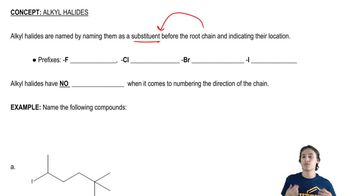
How to name alkyl halides