Ch. 13 - Alcohols, Ethers and Related Compounds: Substitution and Elimination
Mullins - Organic Chemistry: A Learner Centered Approach 1st Edition
Mullins1st EditionOrganic Chemistry: A Learner Centered ApproachISBN: 9780137566471Not the one you use?Change textbook
Chapter 12, Problem 88a(iii)

Predict the product(s) that would result when the following molecules are allowed to react under the following conditions: (iii) H2SO4 , H2O . If there is no reaction, write 'no reaction.'
(a) Chemical structure of styrene, featuring a benzene ring attached to a vinyl group.

Verified step by step guidance
1
Step 1: Identify the type of reaction that occurs under the given conditions. The presence of H₂SO₄ (sulfuric acid) and H₂O (water) typically indicates an acid-catalyzed hydration reaction, which is common for alkenes. This reaction adds a water molecule (H and OH) across the double bond of an alkene.
Step 2: Examine the structure of the given molecule. Check if the molecule contains a double bond (C=C). If no double bond is present, there will be 'no reaction' under these conditions.
Step 3: If the molecule contains a double bond, determine the regioselectivity of the reaction. Acid-catalyzed hydration follows Markovnikov's rule, meaning the OH group will add to the more substituted carbon of the double bond, while the H will add to the less substituted carbon.
Step 4: Consider the possibility of carbocation rearrangement. During the reaction, a carbocation intermediate is formed. If a more stable carbocation can be formed through rearrangement (e.g., hydride or alkyl shift), the reaction will proceed through the rearranged intermediate.
Step 5: Draw the final product(s) by adding the H and OH groups to the appropriate carbons of the double bond, taking into account Markovnikov's rule and any potential rearrangements. If no double bond is present, confirm that the answer is 'no reaction.'

Verified video answer for a similar problem:

This video solution was recommended by our tutors as helpful for the problem above.
Video duration:
2m
Was this helpful?

Key Concepts

Here are the essential concepts you must grasp in order to answer the question correctly.

Acid-Base Reactions

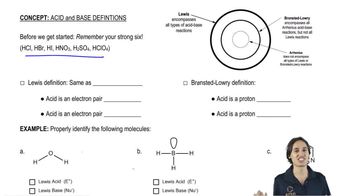
In organic chemistry, acid-base reactions involve the transfer of protons (H⁺) between molecules. Strong acids, like sulfuric acid (H₂SO₄), can donate protons to bases, facilitating various reactions, including hydration and esterification. Understanding the role of acids and bases is crucial for predicting the outcome of reactions involving proton transfer.
Recommended video:
Guided course
02:49
The Lewis definition of acids and bases.

Hydration Reactions

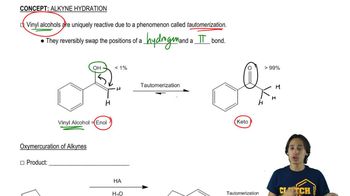
Hydration reactions occur when water (H₂O) adds to a molecule, typically resulting in the formation of alcohols. In the presence of an acid catalyst, such as H₂SO₄, alkenes can undergo hydration to yield alcohols through the Markovnikov addition mechanism. Recognizing the conditions that favor hydration is essential for predicting the products of reactions involving water.
Recommended video:
Guided course
09:11
Alkyne Hydration

Reaction Mechanisms

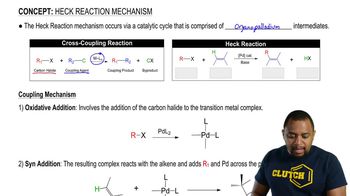
Understanding reaction mechanisms is vital for predicting the products of organic reactions. Mechanisms describe the step-by-step process by which reactants transform into products, including the formation and breaking of bonds. Familiarity with common mechanisms, such as electrophilic addition and nucleophilic substitution, helps in anticipating the outcomes of reactions under specific conditions.
Recommended video:
Guided course
02:16
Heck Reaction Mechanism