Ch. 13 - Alcohols, Ethers and Related Compounds: Substitution and Elimination
Mullins - Organic Chemistry: A Learner Centered Approach 1st Edition
Mullins1st EditionOrganic Chemistry: A Learner Centered ApproachISBN: 9780137566471Not the one you use?Change textbook
Chapter 12, Problem 99

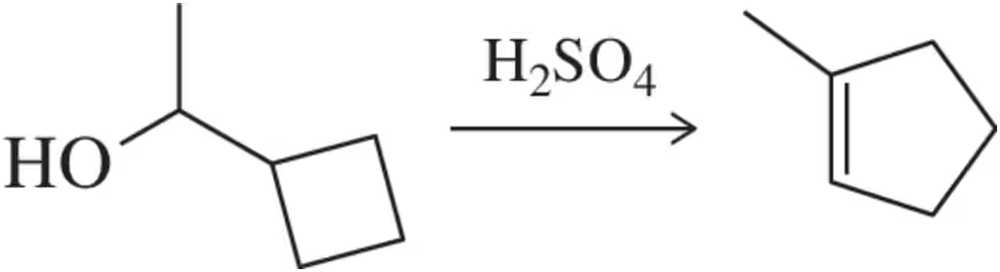
Produce a mechanism for the following transformation.
Chemical reaction diagram showing dehydration of an alcohol to form an alkene, with sulfuric acid as a catalyst.

Verified step by step guidance
1
Step 1: Identify the functional groups in the starting material and the product. Analyze the transformation to determine what type of reaction is occurring (e.g., substitution, elimination, addition, rearrangement). This will help guide the mechanism.
Step 2: Determine the reagents and conditions provided (if any). These will influence the type of reaction mechanism and the intermediates formed during the process.
Step 3: Draw the starting material and propose the first step of the mechanism. This often involves identifying the most reactive site in the molecule, such as a nucleophilic or electrophilic center, and showing how the reagent interacts with it. Use curved arrows to indicate electron movement.
Step 4: Continue the mechanism by showing the formation of intermediates. For example, if a carbocation or radical intermediate is formed, ensure you explain its stability and how it leads to the next step in the reaction.
Step 5: Complete the mechanism by showing the final step that leads to the product. Ensure all charges are balanced, and all atoms are accounted for. Verify that the product matches the transformation described in the problem.

Verified video answer for a similar problem:

This video solution was recommended by our tutors as helpful for the problem above.
Video duration:
1m
Was this helpful?

Key Concepts

Here are the essential concepts you must grasp in order to answer the question correctly.

Reaction Mechanism

A reaction mechanism is a step-by-step description of the process by which reactants are converted into products in a chemical reaction. It outlines the individual steps, including bond breaking and formation, and the intermediates formed along the way. Understanding the mechanism is crucial for predicting the outcome of reactions and for designing new synthetic pathways.
Recommended video:
Guided course
02:16
Heck Reaction Mechanism

Functional Groups

Functional groups are specific groups of atoms within molecules that are responsible for the characteristic chemical reactions of those molecules. They determine the reactivity and properties of organic compounds. Identifying functional groups in the reactants and products is essential for predicting how a transformation will occur and what mechanisms may be involved.
Recommended video:
Guided course
02:36
Identifying Functional Groups

Catalysis

Catalysis refers to the process of increasing the rate of a chemical reaction by adding a substance known as a catalyst, which is not consumed in the reaction. Catalysts can provide an alternative pathway with a lower activation energy, making reactions more efficient. Understanding the role of catalysts is important in many organic transformations, as they can significantly influence the mechanism and outcome.
Recommended video:
2:31
Nucleophilic Catalysis Concept 1