Ch. 13 - Alcohols, Ethers and Related Compounds: Substitution and Elimination
Mullins - Organic Chemistry: A Learner Centered Approach 1st Edition
Mullins1st EditionOrganic Chemistry: A Learner Centered ApproachISBN: 9780137566471Not the one you use?Change textbook
Chapter 12, Problem 15b

Suggest a reagent and a reactant that could be combined to make each of the following alcohols.
(b) Chemical structure showing a cyclohexane with two hydroxyl (OH) groups, indicating a reaction with unknown reactants.

Verified step by step guidance
1
Step 1: Identify the target alcohol structure. Analyze the molecular formula and functional groups present in the alcohol to determine its classification (primary, secondary, or tertiary). This will help guide the choice of reagent and reactant.
Step 2: Consider the synthetic pathway. Alcohols can be synthesized through various methods, such as reduction of carbonyl compounds, hydroboration-oxidation of alkenes, or nucleophilic substitution reactions. Select the most appropriate method based on the target alcohol.
Step 3: If the alcohol is primary, consider using a reduction reaction. For example, aldehydes can be reduced to primary alcohols using reagents like sodium borohydride (NaBH₄) or lithium aluminum hydride (LiAlH₄). Write the general reaction: RCHO+HRCH₂OH
Step 4: If the alcohol is secondary, consider reducing a ketone. Ketones can be reduced to secondary alcohols using similar reagents (NaBH₄ or LiAlH₄). Write the general reaction: RCO+HRCHOH
Step 5: If the alcohol is tertiary, consider alternative methods such as hydroboration-oxidation of alkenes. For example, a tertiary alcohol can be synthesized by reacting an alkene with borane (BH₃) followed by oxidation with hydrogen peroxide (H₂O₂) in basic conditions. Write the general reaction: RCH=CH₂RC(OH)R

Verified video answer for a similar problem:

This video solution was recommended by our tutors as helpful for the problem above.
Video duration:
1m
Was this helpful?

Key Concepts

Here are the essential concepts you must grasp in order to answer the question correctly.

Alcohol Functional Group

Alcohols are organic compounds characterized by the presence of one or more hydroxyl (-OH) groups attached to a carbon atom. The position and number of these hydroxyl groups influence the properties and reactivity of the alcohol. Understanding the structure of alcohols is essential for identifying suitable reactants and reagents for their synthesis.
Recommended video:
Guided course
02:36
Identifying Functional Groups

Nucleophilic Substitution Reactions

Nucleophilic substitution reactions involve the replacement of a leaving group in a molecule with a nucleophile, which is an electron-rich species. In the context of alcohol synthesis, this often occurs when a halide or other leaving group is replaced by a hydroxyl group. Recognizing the mechanism of these reactions is crucial for proposing appropriate reagents and reactants.
Recommended video:
Guided course
01:47
Nucleophiles and Electrophiles can react in Substitution Reactions.

Reagents for Alcohol Synthesis

Common reagents used to synthesize alcohols include Grignard reagents, alkyl halides, and carbonyl compounds. For example, a Grignard reagent can react with a carbonyl compound to form an alcohol. Knowing the reactivity and compatibility of these reagents with various reactants is vital for successfully proposing a synthesis pathway for specific alcohols.
Recommended video:
Guided course
01:37
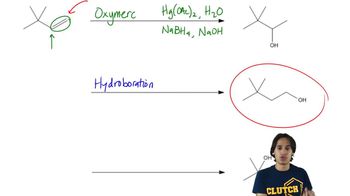
Forming alcohols through Hydroboration-Oxidation.