Ch. 13 - Alcohols, Ethers and Related Compounds: Substitution and Elimination
Mullins - Organic Chemistry: A Learner Centered Approach 1st Edition
Mullins1st EditionOrganic Chemistry: A Learner Centered ApproachISBN: 9780137566471Not the one you use?Change textbook
Chapter 12, Problem 111

We explain in Chapter 24 that bisphenols can be oxidized to quinones.
(a) Calculate the oxidation numbers of C1 and C₂ in going from reactant to product.
(b) Provide a mechanism for this transformation. [The reaction begins like the alcohol oxidations of Section 13.9.]


Chemical reaction showing the oxidation of bisphenol to quinone, with numbered carbon atoms and reagents labeled.

Verified step by step guidance
1
Identify the structure of the reactant and product. The reactant is a bisphenol with hydroxyl groups on C1 and C2, and the product is a quinone with carbonyl groups on C1 and C2.
Calculate the oxidation number of C1 and C2 in the reactant. In the bisphenol, each carbon (C1 and C2) is bonded to an -OH group and two other carbons. Assign oxidation numbers based on these bonds.
Calculate the oxidation number of C1 and C2 in the product. In the quinone, each carbon (C1 and C2) is bonded to an oxygen (double bond) and two other carbons. Assign oxidation numbers based on these bonds.
Compare the oxidation numbers of C1 and C2 in the reactant and product to determine the change in oxidation state, indicating oxidation.
Outline the mechanism for the transformation. The reaction begins with the formation of a chromate ester intermediate, followed by elimination to form the carbonyl groups, similar to alcohol oxidation mechanisms.

Verified video answer for a similar problem:

This video solution was recommended by our tutors as helpful for the problem above.
Was this helpful?

Key Concepts

Here are the essential concepts you must grasp in order to answer the question correctly.

Oxidation Numbers

Oxidation numbers are a way to keep track of electron transfer in chemical reactions. They indicate the degree of oxidation of an atom in a compound, helping to identify how many electrons are lost or gained. In the context of the transformation from bisphenols to quinones, calculating the oxidation numbers of specific carbon atoms (C1 and C2) allows us to understand the changes in electron density and the overall oxidation state during the reaction.
Recommended video:
Guided course
03:40
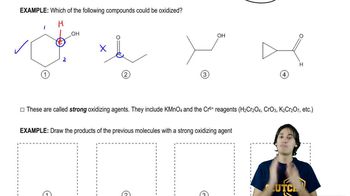
Strong oxidizing agents

Mechanism of Oxidation

The mechanism of oxidation describes the step-by-step process by which a reactant is converted into a product through the breaking and forming of bonds. In the case of bisphenols oxidizing to quinones, the mechanism typically involves the removal of hydrogen atoms and the formation of double bonds, which can be illustrated using curved arrows to show electron movement. Understanding this mechanism is crucial for predicting the behavior of similar organic reactions.
Recommended video:
Guided course
01:31
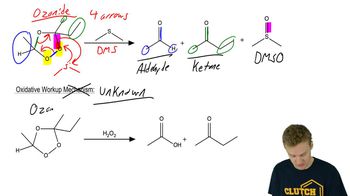
Oxidative Workup Mechanism:

Alcohol Oxidation

Alcohol oxidation refers to the chemical process where alcohols are converted into carbonyl compounds, such as aldehydes or ketones, often involving the loss of hydrogen. This process is fundamental in organic chemistry and serves as a basis for understanding more complex transformations, such as the oxidation of bisphenols to quinones. Familiarity with the principles of alcohol oxidation helps in grasping the underlying reactions and mechanisms involved in the transformation discussed in the question.
Recommended video:
Guided course
05:53
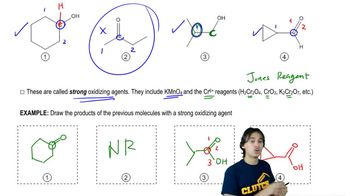
Strong oxidizing agents
Related Practice
Textbook Question

Thiols are prone to dimerize through the formation of a disulfide bond in a reaction that stylists use to induce permanent curls in hair. What type of reagent would you use to effect this transformation?

1035
views

Textbook Question

Triphenylphosphine and iodine can be used to convert alcohols to iodoalkanes. Suggest a mechanism for this reaction. [Triphenylphosphine first acts as a nucleophile in this reaction.]

1480
views
Textbook Question

Cleavage of the following ether produces the alcohol and haloalkane only, regardless of how much HBr is used. Thinking about the mechanism of the reaction, explain why bromobenzene is not also a product of this reaction.

850
views
Textbook Question

A chemist attempted the reaction below, one we introduce in Chapter 17, expecting the reaction between a strong nucleophile and a ketone in water to give an alkoxide product.

(a) Why did the reaction fail?

(b) How could the reaction conditions be changed to give a successful reaction?

980
views
Textbook Question

In Chapter 12, we learned that crown ethers were used to increase the rate of SN2 reactions (Assessment 12.80). Suggest a synthesis of 15-crown-5 using the reactions learned here in Chapter 13.

888
views
Textbook Question

Another method for converting alcohols to chloroalkanes makes use of chlorotrimethylsilane (TMSCl) and DMSO. Suggest a mechanism for this reaction to form (a) a 1° chloroalkane and (b) a 3° chloroalkane. [The reaction begins by the reaction of DMSO and TMSCl and is analogous to the Swern oxidation.]


851
views