Ch. 13 - Alcohols, Ethers and Related Compounds: Substitution and Elimination
Mullins - Organic Chemistry: A Learner Centered Approach 1st Edition
Mullins1st EditionOrganic Chemistry: A Learner Centered ApproachISBN: 9780137566471Not the one you use?Change textbook
Chapter 12, Problem 29

Using an excess of HCl in the following reaction resulted in a product that was not simply the substitution of chlorine for the hydroxyl group. Predict the identity of the product obtained.

Verified step by step guidance
1
Step 1: Analyze the starting material, which is a cyclohexanol derivative. The hydroxyl group (-OH) is attached to a cyclohexane ring with a methyl group at the 1-position.
Step 2: Recognize that the reaction involves an excess of HCl. In acidic conditions, the hydroxyl group can be protonated to form water, which is a good leaving group. This sets the stage for a substitution or elimination reaction.
Step 3: Consider the possibility of carbocation formation. When the hydroxyl group leaves as water, a carbocation intermediate is formed at the 1-position. The stability of this carbocation is crucial for determining the reaction pathway.
Step 4: Evaluate the carbocation stability. The carbocation at the 1-position can undergo a hydride shift or methyl shift to form a more stable tertiary carbocation at the 2-position. This rearrangement is common in reactions involving carbocations.
Step 5: Predict the final product. Instead of simple substitution of chlorine for the hydroxyl group, the rearranged tertiary carbocation reacts with chloride ion (Cl⁻) from HCl to form a tertiary alkyl chloride at the 2-position. This explains why the product is not the direct substitution product.

Verified video answer for a similar problem:

This video solution was recommended by our tutors as helpful for the problem above.
Video duration:
4m
Was this helpful?

Key Concepts

Here are the essential concepts you must grasp in order to answer the question correctly.

Nucleophilic Substitution

Nucleophilic substitution is a fundamental reaction in organic chemistry where a nucleophile replaces a leaving group in a molecule. In this context, the hydroxyl group (-OH) acts as a leaving group, and HCl provides chloride ions (Cl-) that can act as nucleophiles. Understanding this mechanism is crucial for predicting the outcome of reactions involving alcohols and halogen acids.
Recommended video:
Guided course
01:47
Nucleophiles and Electrophiles can react in Substitution Reactions.

Rearrangement Reactions

Rearrangement reactions involve the structural reorganization of a molecule, often leading to the formation of more stable products. In the presence of excess HCl, the reaction may not only substitute the hydroxyl group but also rearrange the carbon skeleton, resulting in a different product than expected. Recognizing the potential for rearrangement is essential for predicting the final product.
Recommended video:
Guided course
06:08
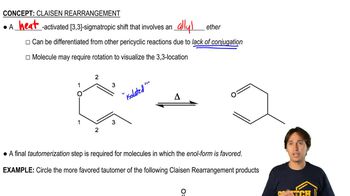
Definition of Claisen Rearrangement

Carbocation Stability

Carbocation stability is a key concept in organic chemistry that influences reaction pathways. Carbocations are positively charged carbon species that can form during nucleophilic substitution or rearrangement reactions. The stability of these intermediates, which can be primary, secondary, or tertiary, affects the likelihood of different products forming, especially when excess reagents are present.
Recommended video:
Guided course
05:58
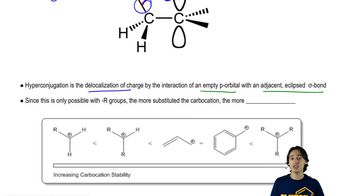
Determining Carbocation Stability