Ch. 13 - Alcohols, Ethers and Related Compounds: Substitution and Elimination
Mullins - Organic Chemistry: A Learner Centered Approach 1st Edition
Mullins1st EditionOrganic Chemistry: A Learner Centered ApproachISBN: 9780137566471Not the one you use?Change textbook
Chapter 12, Problem 18

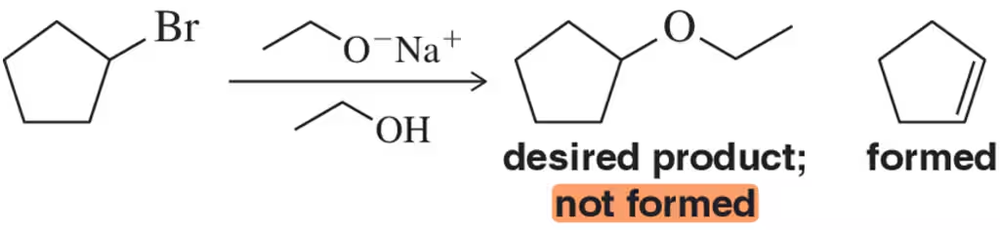
When a secondary haloalkane is treated with sodium ethoxide in ethanol, we predict alkene formation over ether formation. How did we make this determination?
Chemical reaction diagram showing a secondary haloalkane reacting with sodium ethoxide, predicting alkene formation, not ether.

Verified step by step guidance
1
Identify the type of reaction: Sodium ethoxide (NaOCH₂CH₃) in ethanol is a strong base and a good nucleophile. This suggests that the reaction could proceed via either an elimination (E2) or substitution (SN2) mechanism.
Analyze the substrate: A secondary haloalkane is sterically hindered, which makes it less favorable for a nucleophile to attack the carbon bearing the leaving group (SN2 mechanism). This steric hindrance favors elimination (E2) over substitution.
Consider the reaction conditions: Sodium ethoxide is a strong base, and ethanol is a polar protic solvent. These conditions favor the E2 elimination mechanism, as strong bases promote the removal of a β-hydrogen to form an alkene.
Predict the major product: In an E2 reaction, the β-hydrogen is abstracted by the base, and the leaving group departs simultaneously, leading to the formation of a double bond (alkene). Ether formation would require an SN2 mechanism, which is less likely under these conditions.
Conclude the reasoning: The combination of a strong base, polar protic solvent, and steric hindrance of the secondary haloalkane makes alkene formation via E2 elimination the predominant pathway over ether formation.

Verified video answer for a similar problem:

This video solution was recommended by our tutors as helpful for the problem above.
Was this helpful?

Key Concepts

Here are the essential concepts you must grasp in order to answer the question correctly.

Nucleophilic Substitution vs. Elimination

In organic chemistry, reactions involving haloalkanes can proceed via nucleophilic substitution (SN) or elimination (E) mechanisms. Secondary haloalkanes can undergo both SN2 and E2 reactions. The choice between these pathways depends on factors such as the strength of the nucleophile, the solvent, and the structure of the substrate.
Recommended video:
Guided course
00:38
Intro to Substitution/Elimination Problems

Role of Sodium Ethoxide

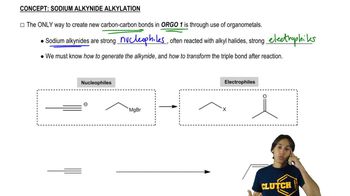
Sodium ethoxide (NaOEt) is a strong base and a good nucleophile. In the presence of a secondary haloalkane, it can promote elimination reactions, leading to alkene formation. The basicity of sodium ethoxide favors the E2 mechanism, especially in a protic solvent like ethanol, which can stabilize the transition state of the elimination pathway.
Recommended video:
Guided course
03:19
Sodium Alkynide Alkylation

Solvent Effects on Reaction Pathways

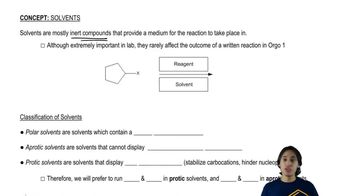
The choice of solvent significantly influences the reaction mechanism. Ethanol, being a polar protic solvent, can stabilize ions and transition states. In this case, it favors elimination over substitution because the solvent can stabilize the alkene product and the leaving group, thus promoting the formation of alkenes from secondary haloalkanes.
Recommended video:
Guided course
02:26
General format of reactions and how to interpret solvents.