Ch. 13 - Alcohols, Ethers and Related Compounds: Substitution and Elimination
Mullins - Organic Chemistry: A Learner Centered Approach 1st Edition
Mullins1st EditionOrganic Chemistry: A Learner Centered ApproachISBN: 9780137566471Not the one you use?Change textbook
Chapter 12, Problem 21e

Which of the following bases would favorably deprotonate a hydroxyl group?
(e) Sodium ethoxide chemical structure, showing ethyl group bonded to negatively charged oxygen and positively charged sodium ion.

Verified step by step guidance
1
Identify the pKa of the hydroxyl group. Hydroxyl groups typically have a pKa around 16-18.
Consider the concept of acid-base reactions, where a base will deprotonate an acid if the base is stronger than the conjugate base of the acid. This means the base should have a higher pKa than the hydroxyl group.
Examine the list of bases provided in the problem. Compare the pKa values of these bases to the pKa of the hydroxyl group.
Select the base with a pKa higher than that of the hydroxyl group, as it will be more likely to deprotonate the hydroxyl group.
Remember that steric hindrance and solvent effects can also influence the ability of a base to deprotonate a hydroxyl group, but the primary factor is the relative pKa values.

Verified video answer for a similar problem:

This video solution was recommended by our tutors as helpful for the problem above.
Video duration:
5m
Was this helpful?

Key Concepts

Here are the essential concepts you must grasp in order to answer the question correctly.

Acid-Base Chemistry

Acid-base chemistry involves the transfer of protons between molecules. A base is a substance that can accept protons, while an acid can donate them. Understanding the strength of acids and bases is crucial, as stronger bases are more likely to deprotonate acids, such as hydroxyl groups, by accepting their protons.
Recommended video:
Guided course
02:49
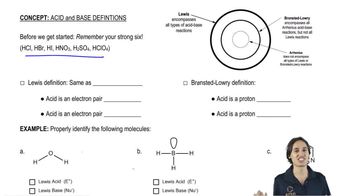
The Lewis definition of acids and bases.

pKa and Basicity

The pKa value is a measure of the acidity of a substance, indicating how easily it can donate a proton. A lower pKa means a stronger acid. Basicity refers to a base's ability to accept protons. To deprotonate a hydroxyl group, the base must have a higher basicity than the hydroxyl's acidity, which is reflected in its pKa.
Recommended video:
Guided course
07:45
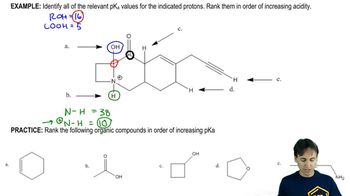
Identifying pKa values

Hydroxyl Group Characteristics

A hydroxyl group consists of an oxygen atom bonded to a hydrogen atom (-OH). It is a polar group, making it capable of forming hydrogen bonds. The acidity of the hydroxyl group is relatively weak, so a base must be sufficiently strong to deprotonate it, meaning it must have a higher affinity for protons than the hydroxyl group itself.
Recommended video:
Guided course
04:42
Sequence Groups