Ch. 14 - Structural Identification I: Infrared Spectroscopy and Mass Spectrometry
Mullins - Organic Chemistry: A Learner Centered Approach 1st Edition
Mullins1st EditionOrganic Chemistry: A Learner Centered ApproachISBN: 9780137566471Not the one you use?Change textbook
Chapter 13, Problem 47b

Choose the bond in each pair that you expect to have the more intense stretching band
(b) C=O vs. C=N

Verified step by step guidance
1
Identify the type of bonds in question: C=O (carbon-oxygen double bond) and C=N (carbon-nitrogen double bond).
Understand that the intensity of an IR stretching band is influenced by the dipole moment change during the vibration. A greater change in dipole moment results in a more intense band.
Consider the electronegativity of the atoms involved: Oxygen is more electronegative than nitrogen, which means the C=O bond will have a greater dipole moment compared to the C=N bond.
Recognize that the greater the difference in electronegativity between the bonded atoms, the more polar the bond, and thus, the more intense the IR absorption band.
Conclude that the C=O bond is expected to have a more intense stretching band than the C=N bond due to the higher dipole moment change during vibration.

Verified video answer for a similar problem:

This video solution was recommended by our tutors as helpful for the problem above.
Was this helpful?

Key Concepts

Here are the essential concepts you must grasp in order to answer the question correctly.

Infrared Spectroscopy

Infrared (IR) spectroscopy is a technique used to identify functional groups in organic molecules by measuring the absorption of infrared light, which causes molecular vibrations. The intensity of the absorption band in an IR spectrum is related to the change in dipole moment during the vibration. A greater change in dipole moment results in a more intense absorption band.
Recommended video:
2:56
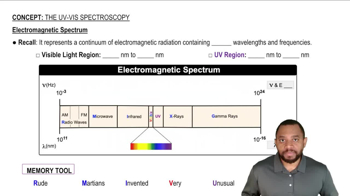
The UV-Vis Spectroscopy Concept 1

Dipole Moment

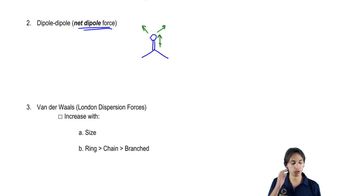
The dipole moment is a measure of the separation of positive and negative charges in a molecule. It is a vector quantity, with both magnitude and direction, and is crucial in determining the intensity of IR absorption bands. Bonds with larger dipole moments typically exhibit more intense stretching bands in IR spectroscopy due to greater changes in dipole moment during vibration.
Recommended video:
Guided course
01:46
How dipole-dipole forces work.

Bond Polarity and Electronegativity

Bond polarity arises from differences in electronegativity between two bonded atoms, leading to an uneven distribution of electron density. In the context of IR spectroscopy, more polar bonds, such as C=O, tend to have more intense stretching bands compared to less polar bonds like C=N, due to the larger change in dipole moment during vibration.
Recommended video:
Guided course
1:47
Electronegativity