Textbook Question
Would you expect the stretching band of the carbonyl to appear at a higher frequency for cyclohexanecarbaldehyde or benzaldehyde? Explain.
1017
views

 Mullins 1st EditionCh. 14 - Structural Identification I: Infrared Spectroscopy and Mass SpectrometryProblem 52
 Verified step by step guidance
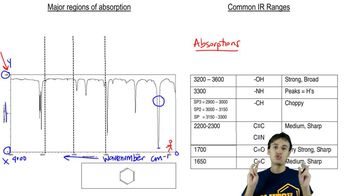
 16:04
16:04
 01:23
01:23 04:43
04:43Would you expect the stretching band of the carbonyl to appear at a higher frequency for cyclohexanecarbaldehyde or benzaldehyde? Explain.
A carboxylic acid can be converted to an ester using the conditions shown. Explain how a comparison of an IR spectrum of the reactant(s) and product can be used to determine whether the reaction was successful or not.
Identify the important bands you would expect to find in an IR spectrum for the following molecules.
(c)
What functional groups might be present in the IR spectra for the molecules with the given molecular formulas. [Be sure to use the molecular formula in your analysis.]
(b) C₃H₄O₄
<IMAGE>
Under acidic conditions, alkene A can be isomerized to the more stable alkene B. How could IR spectroscopy be used to distinguish between A and B? [There are a few correct answers.]
Justify the carbonyl stretching frequencies indicated for benzaldehyde and 4-methoxybenzaldehyde.