Ch. 14 - Structural Identification I: Infrared Spectroscopy and Mass Spectrometry
Mullins - Organic Chemistry: A Learner Centered Approach 1st Edition
Mullins1st EditionOrganic Chemistry: A Learner Centered ApproachISBN: 9780137566471Not the one you use?Change textbook
Chapter 13, Problem 22d

Match each of the four IR spectra to one of the given compounds. [One of the compounds does not match a spectrum.]
(d) <IMAGE>

Verified step by step guidance
1
Begin by understanding the basic principles of IR spectroscopy. Infrared (IR) spectroscopy is a technique used to identify functional groups in organic compounds based on the absorption of infrared light at specific wavelengths.
Examine the IR spectra provided. Look for key absorption peaks that correspond to specific functional groups. Common peaks include: O-H stretch (around 3200-3600 cm-1), C=O stretch (around 1700 cm-1), C-H stretch (around 2800-3000 cm-1), and N-H stretch (around 3300-3500 cm-1).
Identify the functional groups present in each of the given compounds. For example, if a compound contains a carbonyl group, you should expect a peak around 1700 cm-1 in its IR spectrum.
Match the observed peaks in each IR spectrum to the functional groups identified in the compounds. This involves comparing the characteristic absorption frequencies of the functional groups in the compounds to the peaks in the spectra.
Determine which compound does not match any of the IR spectra. This compound will have functional groups that do not correspond to the peaks observed in any of the spectra provided.

Verified video answer for a similar problem:

This video solution was recommended by our tutors as helpful for the problem above.
Was this helpful?

Key Concepts

Here are the essential concepts you must grasp in order to answer the question correctly.

Infrared Spectroscopy

Infrared spectroscopy is a technique used to identify functional groups in organic compounds by measuring the absorption of infrared light. Different bonds absorb specific frequencies, creating a spectrum that acts as a molecular fingerprint. Understanding IR spectra involves recognizing characteristic peaks corresponding to various functional groups.
Recommended video:
2:56
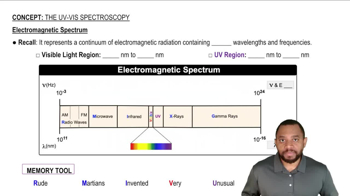
The UV-Vis Spectroscopy Concept 1

Functional Groups

Functional groups are specific groups of atoms within molecules that are responsible for the characteristic chemical reactions of those molecules. In IR spectroscopy, each functional group has a unique absorption pattern, allowing chemists to identify them based on the presence and position of peaks in the spectrum.
Recommended video:
Guided course
02:36
Identifying Functional Groups

Spectral Analysis

Spectral analysis involves interpreting the peaks and patterns in an IR spectrum to deduce the structure of a compound. This requires knowledge of typical absorption ranges for different functional groups and the ability to match these with the spectra provided. It is crucial to compare the spectra with known reference data to accurately identify the compound.
Recommended video:
Guided course
04:04
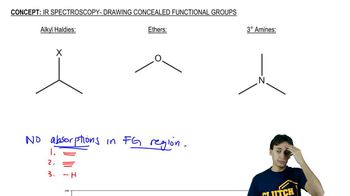
Drawing Concealed Functional Groups