Ch. 15 - Structural Identification II: Nuclear Magnetic Resonance Spectroscopy
Mullins - Organic Chemistry: A Learner Centered Approach 1st Edition
Mullins1st EditionOrganic Chemistry: A Learner Centered ApproachISBN: 9780137566471Not the one you use?Change textbook
Chapter 14, Problem 74

A graduate student ran a reaction that produced a mixture of the following two compounds. After painstaking purification, she is able to separate the two compounds. Using ¹H NMR, how can she determine which diastereomer is in which separated sample?
Two chemical structures of diastereomers with hydroxyl groups, illustrating E/Z isomerism in organic compounds.

Verified step by step guidance
1
Identify the two diastereomers: The first compound has the hydroxyl group (OH) and the methyl group on opposite sides of the cyclohexane ring (trans configuration), while the second compound has both groups on the same side (cis configuration).
Understand the impact of stereochemistry on ¹H NMR: In cyclohexane rings, axial and equatorial positions can lead to different chemical shifts due to steric and electronic environments. The trans diastereomer will have different chemical shifts compared to the cis diastereomer.
Analyze the ¹H NMR spectrum: Look for the chemical shift of the protons on the carbon bearing the hydroxyl group. In the trans diastereomer, the axial-equatorial relationship will cause a distinct splitting pattern and chemical shift compared to the cis diastereomer.
Consider the coupling constants: The coupling constant (J value) between the protons on the carbon with the hydroxyl group and adjacent protons will differ between the trans and cis diastereomers. Trans diastereomers typically have larger coupling constants due to the dihedral angle between the protons.
Compare the integration of signals: The integration of the signals in the ¹H NMR spectrum will help confirm the number of protons contributing to each signal, allowing you to match the spectrum to the correct diastereomer based on the expected number of protons in each environment.

Verified video answer for a similar problem:

This video solution was recommended by our tutors as helpful for the problem above.
Video duration:
6m
Was this helpful?

Key Concepts

Here are the essential concepts you must grasp in order to answer the question correctly.

Diastereomers

Diastereomers are stereoisomers that are not mirror images of each other. They have different physical and chemical properties, which can be exploited in analytical techniques. Understanding the specific structural differences between diastereomers is crucial for identifying them in a mixture, especially when using methods like NMR spectroscopy.
Recommended video:
Guided course
03:44
Using chiral centers to predict types of stereoisomers.

Nuclear Magnetic Resonance (NMR) Spectroscopy

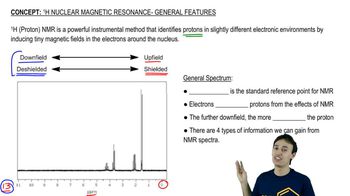
NMR spectroscopy is a powerful analytical technique used to determine the structure of organic compounds. It provides information about the number of hydrogen atoms in a molecule and their environment, allowing for the differentiation of diastereomers based on their unique chemical shifts and splitting patterns in the spectrum.
Recommended video:
Guided course
10:06
General NMR Features

Chemical Shifts

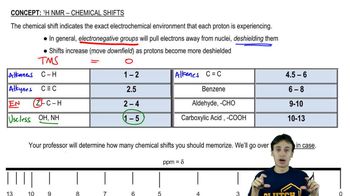
Chemical shifts in NMR spectroscopy refer to the resonance frequency of a nucleus relative to a standard in a magnetic field. They are influenced by the electronic environment surrounding the nuclei, which varies between diastereomers. By analyzing the chemical shifts, one can distinguish between the diastereomers present in the separated samples.
Recommended video:
Guided course
11:44
1H NMR Chemical Shifts