Ch. 15 - Structural Identification II: Nuclear Magnetic Resonance Spectroscopy
Mullins - Organic Chemistry: A Learner Centered Approach 1st Edition
Mullins1st EditionOrganic Chemistry: A Learner Centered ApproachISBN: 9780137566471Not the one you use?Change textbook
Chapter 14, Problem 54a

Draw the expected results of a DEPT sequence for the molecules shown.
(a) Chemical structure of ethyl acetate, showing a carbon chain with a double-bonded oxygen and an ethoxy group.

Verified step by step guidance
1
Identify the carbon atoms in the molecule and classify them based on the number of hydrogen atoms attached. In DEPT (Distortionless Enhancement by Polarization Transfer) NMR, carbon atoms are classified as CH3, CH2, CH, or quaternary (C with no hydrogens).
Understand the DEPT sequence: DEPT-90 shows only CH groups, DEPT-135 shows CH and CH3 as positive peaks and CH2 as negative peaks, while quaternary carbons do not appear in any DEPT spectrum.
Draw the DEPT-90 spectrum: Only include peaks for carbon atoms that are bonded to exactly one hydrogen atom (CH groups).
Draw the DEPT-135 spectrum: Include positive peaks for CH and CH3 groups, and negative peaks for CH2 groups. Quaternary carbons will not appear.
Review the drawn spectra to ensure that all carbon types are correctly represented according to the DEPT sequence rules, and adjust if necessary.

Verified video answer for a similar problem:

This video solution was recommended by our tutors as helpful for the problem above.
Was this helpful?

Key Concepts

Here are the essential concepts you must grasp in order to answer the question correctly.

DEPT NMR Spectroscopy

Distortionless Enhancement by Polarization Transfer (DEPT) is a technique in NMR spectroscopy used to determine the number of hydrogen atoms attached to carbon atoms in a molecule. It differentiates between CH, CH2, and CH3 groups by varying the pulse angles, providing a clearer understanding of the molecular structure.
Recommended video:
Guided course
10:06
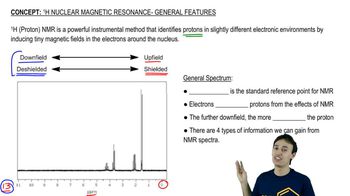
General NMR Features

Carbon-13 NMR

Carbon-13 NMR is a type of nuclear magnetic resonance spectroscopy that focuses on the carbon-13 isotope. It provides information about the carbon skeleton of organic compounds, helping to identify different carbon environments within a molecule. This technique is crucial for interpreting DEPT spectra, as it forms the basis for understanding carbon-hydrogen connectivity.
Recommended video:
Guided course
04:00
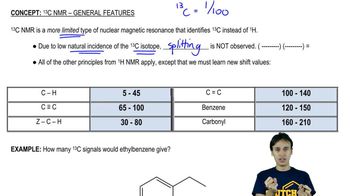
13C NMR General Features

Chemical Shift

Chemical shift in NMR spectroscopy refers to the resonant frequency of a nucleus relative to a standard in a magnetic field. It provides insights into the electronic environment surrounding a nucleus, influenced by factors like electronegativity and hybridization. Understanding chemical shifts is essential for interpreting NMR spectra, including DEPT, as it helps identify different types of carbon atoms in a molecule.
Recommended video:
Guided course
11:44
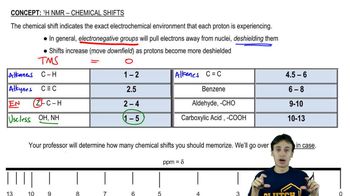
1H NMR Chemical Shifts