Ch. 15 - Structural Identification II: Nuclear Magnetic Resonance Spectroscopy
Mullins - Organic Chemistry: A Learner Centered Approach 1st Edition
Mullins1st EditionOrganic Chemistry: A Learner Centered ApproachISBN: 9780137566471Not the one you use?Change textbook
Chapter 14, Problem 46c

How many signals would you expect in the ¹³C NMR spectrum of each molecule shown?
(c)

Verified step by step guidance
1
Identify the molecule in question. Understanding the structure is crucial for predicting the number of signals in the ¹³C NMR spectrum.
Recognize that each unique carbon environment in the molecule will produce a distinct signal in the ¹³C NMR spectrum. Carbons in identical environments will produce the same signal.
Examine the symmetry of the molecule. Symmetrical molecules often have fewer unique carbon environments because some carbons are equivalent due to symmetry.
Count the number of unique carbon environments. Look for differences in hybridization, connectivity, and chemical surroundings that might make one carbon environment distinct from another.
Consider any factors that might cause chemical shift equivalence, such as rapid rotation or conformational averaging, which can reduce the number of observed signals.

Verified video answer for a similar problem:

This video solution was recommended by our tutors as helpful for the problem above.
Was this helpful?

Key Concepts

Here are the essential concepts you must grasp in order to answer the question correctly.

Carbon-13 NMR Spectroscopy

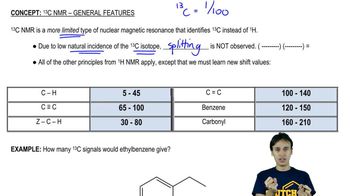
Carbon-13 NMR spectroscopy is a technique used to determine the structure of organic compounds by analyzing the magnetic environment of carbon atoms. Each unique carbon environment in a molecule produces a distinct signal in the spectrum, allowing chemists to infer structural details based on the number and position of these signals.
Recommended video:
Guided course
04:00
13C NMR General Features

Chemical Equivalence

Chemical equivalence refers to the condition where atoms or groups in a molecule are indistinguishable in terms of their chemical environment. In ¹³C NMR, chemically equivalent carbon atoms produce a single signal, as they experience the same magnetic environment, simplifying the spectrum and aiding in structural analysis.
Recommended video:
3:11
Chemical Reactions of Phosphate Anhydrides Concept 1

Symmetry in Molecules

Symmetry in molecules affects the number of signals observed in NMR spectroscopy. Symmetrical molecules often have fewer unique carbon environments due to equivalent positions, leading to fewer signals. Recognizing symmetry helps predict the number of signals and understand the molecular structure more efficiently.
Recommended video:
Guided course
00:25
Determining Chirality with Plane of Symmetry