Ch. 15 - Structural Identification II: Nuclear Magnetic Resonance Spectroscopy
Mullins - Organic Chemistry: A Learner Centered Approach 1st Edition
Mullins1st EditionOrganic Chemistry: A Learner Centered ApproachISBN: 9780137566471Not the one you use?Change textbook
Chapter 14, Problem 2

Radical chlorination, a reaction studied in Chapters 5 and 11, replaces a hydrogen with a chlorine. Assuming there is no regioselectivity (all hydrogens can react equally), how many different chloroalkanes are possible upon reaction of each alkane with one equivalent of Cl₂
(a)
(b)
(c) Line drawing of a zigzag hydrocarbon chain, representing a generic alkane structure for chemical analysis.
(d) Structural formula of a chloroalkane showing a carbon chain with a chlorine substituent.

Verified step by step guidance
1
Identify the structure of each alkane from the images provided. The first image is cyclohexane, the second is propane, the third is pentane, and the fourth is 2-methylbutane.
For cyclohexane, recognize that all hydrogen atoms are equivalent due to the symmetry of the ring. Therefore, replacing any hydrogen with chlorine will yield the same chloroalkane.
For propane, note that there are two types of hydrogen atoms: those on the terminal carbons and those on the central carbon. Replacing a hydrogen on the terminal carbon will yield 1-chloropropane, while replacing a hydrogen on the central carbon will yield 2-chloropropane.
For pentane, identify the different types of hydrogen atoms based on their positions: terminal, secondary, and tertiary. Each unique position will yield a different chloroalkane upon chlorination.
For 2-methylbutane, consider the different types of hydrogen atoms: those on the primary carbons, secondary carbons, and the tertiary carbon. Each type will result in a different chloroalkane when replaced by chlorine.

Verified video answer for a similar problem:

This video solution was recommended by our tutors as helpful for the problem above.
Was this helpful?

Key Concepts

Here are the essential concepts you must grasp in order to answer the question correctly.

Radical Chlorination

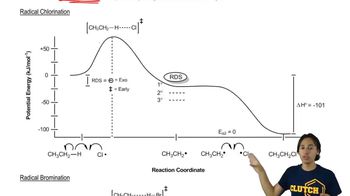
Radical chlorination is a chemical reaction where a chlorine atom replaces a hydrogen atom in an alkane. This process involves the formation of free radicals, typically initiated by heat or light, leading to the homolytic cleavage of Cl₂ into two chlorine radicals. These radicals then react with the alkane, abstracting a hydrogen atom and forming a chloroalkane.
Recommended video:
Guided course
03:03
Using the Hammond Postulate to describe radical chlorination.

Regioselectivity

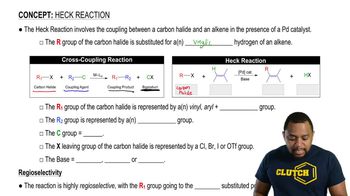
Regioselectivity refers to the preference of a chemical reaction to occur at one location over others in a molecule. In the context of radical chlorination, regioselectivity would dictate which hydrogen atoms are more likely to be replaced by chlorine. However, the question assumes no regioselectivity, meaning all hydrogens are equally likely to react, simplifying the analysis of possible products.
Recommended video:
Guided course
05:09
Heck Reaction

Chloroalkanes

Chloroalkanes are organic compounds where one or more hydrogen atoms in an alkane are replaced by chlorine atoms. The number of different chloroalkanes formed depends on the structure of the original alkane and the positions of the hydrogen atoms. In the absence of regioselectivity, each unique hydrogen position can potentially lead to a different chloroalkane product.