Ch. 15 - Structural Identification II: Nuclear Magnetic Resonance Spectroscopy
Mullins - Organic Chemistry: A Learner Centered Approach 1st Edition
Mullins1st EditionOrganic Chemistry: A Learner Centered ApproachISBN: 9780137566471Not the one you use?Change textbook
Chapter 14, Problem 80

The spectral data below are presented in a manner similar to what you would find in a chemistry research journal. Identify the structure for each set of data.
(c) C₇H₁₄O₂ : ¹H NMR: δ 0.91 (3H, t, J = 7.0 Hz), 1.11 (6H, d, J = 7.0 Hz), 1.82 (2H, sextet), 2.40 (1H, sept, J = 7.0 Hz), 4.14 (2H, t, J = 7.1 Hz); IR (cm ⁻¹) : 1745, 1200

Verified step by step guidance
1
Begin by analyzing the molecular formula C₇H₁₄O₂. Calculate the degree of unsaturation to determine the number of rings and/or double bonds. The formula for degree of unsaturation is: (2C + 2 + N - H - X)/2, where C is the number of carbons, N is the number of nitrogens, H is the number of hydrogens, and X is the number of halogens.
Examine the IR spectrum data. The peak at 1745 cm⁻¹ suggests the presence of a carbonyl group (C=O), which is typical for esters, ketones, or aldehydes. The peak at 1200 cm⁻¹ indicates C-O stretching, which is common in esters.
Analyze the ¹H NMR data: The signal at δ 0.91 (3H, t, J = 7.0 Hz) suggests a terminal methyl group (CH₃) adjacent to a methylene group (CH₂). The signal at δ 1.11 (6H, d, J = 7.0 Hz) indicates two equivalent methyl groups, likely part of an isopropyl group.
Consider the signal at δ 2.40 (1H, sept, J = 7.0 Hz), which is characteristic of a methine proton (CH) in an isopropyl group. The signal at δ 4.14 (2H, t, J = 7.1 Hz) suggests a methylene group (CH₂) adjacent to an electronegative atom, such as oxygen, indicating an ester linkage.
Combine all the information: The degree of unsaturation, IR peaks, and NMR signals suggest the presence of an ester with an isopropyl group and a terminal methyl group. Construct a structure that fits all these data, ensuring the molecular formula C₇H₁₄O₂ is satisfied.

Verified video answer for a similar problem:

This video solution was recommended by our tutors as helpful for the problem above.
Was this helpful?

Key Concepts

Here are the essential concepts you must grasp in order to answer the question correctly.

NMR Spectroscopy

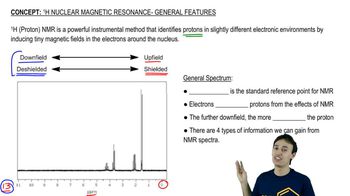
Nuclear Magnetic Resonance (NMR) Spectroscopy is a technique used to determine the structure of organic compounds by analyzing the magnetic properties of atomic nuclei. In ¹H NMR, the chemical shift (δ) indicates the environment of hydrogen atoms, while the splitting pattern (multiplicity) reveals the number of neighboring hydrogens. For example, a triplet (t) suggests two adjacent hydrogens, and a doublet (d) indicates one adjacent hydrogen.
Recommended video:
Guided course
10:06
General NMR Features

IR Spectroscopy

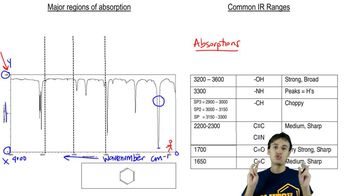
Infrared (IR) Spectroscopy is used to identify functional groups in organic molecules by measuring the absorption of infrared light, which causes molecular vibrations. The absorption peaks are reported in wavenumbers (cm⁻¹). For instance, a peak around 1745 cm⁻¹ typically indicates the presence of a carbonyl group (C=O), while a peak near 1200 cm⁻¹ can suggest C-O stretching in esters or ethers.
Recommended video:
Guided course
16:04
General Features of IR Spect

Molecular Formula and Degree of Unsaturation

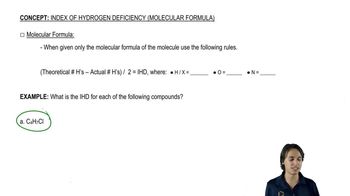
The molecular formula C₇H₁₄O₂ provides the elemental composition of the compound. The degree of unsaturation, calculated using the formula (2C + 2 + N - H - X)/2, helps determine the number of rings and/or multiple bonds. For C₇H₁₄O₂, the degree of unsaturation is 1, indicating one ring or double bond, which is consistent with the presence of a carbonyl group identified in the IR spectrum.
Recommended video:
Guided course
02:17
How to use IHD with molecular formula.