Ch. 16 - Metals in Organic Chemistry
Mullins - Organic Chemistry: A Learner Centered Approach 1st Edition
Mullins1st EditionOrganic Chemistry: A Learner Centered ApproachISBN: 9780137566471Not the one you use?Change textbook
Chapter 15, Problem 16

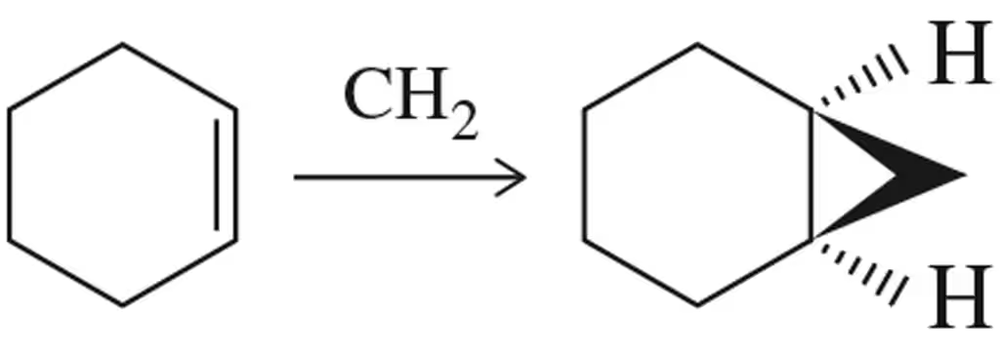
Provide an arrow-pushing mechanism for the cyclopropanation of cyclohexene with methylene carbene. Rationalize the outcome.
Arrow-pushing mechanism showing cyclohexene reacting with methylene carbene to form cyclopropane.

Verified step by step guidance
1
Step 1: Begin by identifying the reactants involved in the cyclopropanation reaction. Cyclohexene is an alkene with a double bond, and methylene carbene (CH₂) is a reactive intermediate with a divalent carbon atom that has two nonbonded electrons. The carbene is highly electrophilic and can interact with the π-electrons of the alkene.
Step 2: Draw the initial interaction between the methylene carbene and the cyclohexene. The π-electrons of the double bond in cyclohexene will attack the electrophilic carbene carbon, forming a new bond. Simultaneously, one of the lone pairs on the carbene carbon will attack the other carbon of the double bond, forming a second bond. This results in the formation of a three-membered cyclopropane ring.
Step 3: Use curved arrows to depict the movement of electrons in the mechanism. Specifically, show the π-electrons of the cyclohexene double bond attacking the carbene carbon, and the lone pair of electrons on the carbene carbon attacking the other carbon of the double bond. This arrow-pushing mechanism illustrates the concerted nature of the reaction.
Step 4: Rationalize the outcome of the reaction. The cyclopropanation occurs because the carbene is highly reactive and can simultaneously form two bonds with the alkene. The strain in the three-membered cyclopropane ring is offset by the stability gained from the formation of two new σ-bonds.
Step 5: Confirm the stereochemistry of the product. If the cyclohexene has substituents, the reaction typically proceeds in a stereospecific manner, preserving the relative configuration of substituents on the double bond. This is due to the concerted nature of the reaction, which avoids intermediate steps that could lead to stereochemical scrambling.

Verified video answer for a similar problem:

This video solution was recommended by our tutors as helpful for the problem above.
Video duration:
2m
Was this helpful?

Key Concepts

Here are the essential concepts you must grasp in order to answer the question correctly.

Cyclopropanation

Cyclopropanation is a chemical reaction that involves the formation of a cyclopropane ring from an alkene. In this process, a three-membered ring is created by the addition of a carbene to the double bond of the alkene. This reaction is significant in organic synthesis as it allows for the construction of strained cyclic structures, which can lead to unique reactivity and properties.
Recommended video:
Guided course
01:49
General properties of cyclopropanation.

Methylene Carbene

Methylene carbene is a reactive species characterized by a carbon atom with a double bond to another carbon and two non-bonding electrons. It acts as a nucleophile in cyclopropanation reactions, attacking the double bond of alkenes. The stability and reactivity of methylene carbene make it a valuable intermediate in organic synthesis, particularly in the formation of cyclopropanes.
Recommended video:
Guided course
01:48
Reaction with a simple carbene.

Arrow-Pushing Mechanism

The arrow-pushing mechanism is a method used in organic chemistry to illustrate the movement of electrons during chemical reactions. It involves using arrows to show the flow of electron pairs from nucleophiles to electrophiles, helping to visualize the formation and breaking of bonds. This technique is essential for understanding reaction pathways, predicting products, and rationalizing the outcomes of reactions like cyclopropanation.
Recommended video:
Guided course
04:32
General Mechanism