Ch. 16 - Metals in Organic Chemistry
Mullins - Organic Chemistry: A Learner Centered Approach 1st Edition
Mullins1st EditionOrganic Chemistry: A Learner Centered ApproachISBN: 9780137566471Not the one you use?Change textbook
Chapter 15, Problem 8b

Predict the product of the following epoxide addition reactions.
(b) Chemical reaction diagram showing a brominated compound undergoing Grignard reaction with steps for reagent addition and quenching.

Verified step by step guidance
1
Identify the structure of the epoxide. An epoxide is a three-membered cyclic ether with significant ring strain, making it highly reactive toward nucleophiles.
Determine the reaction conditions. If the reaction occurs under acidic conditions, the epoxide will be protonated first, making it more electrophilic. If the reaction occurs under basic or neutral conditions, the nucleophile will directly attack the less substituted carbon of the epoxide due to steric hindrance.
Analyze the regioselectivity of the reaction. Under acidic conditions, the nucleophile typically attacks the more substituted carbon of the epoxide due to the formation of a more stable carbocation-like intermediate. Under basic conditions, the nucleophile attacks the less substituted carbon due to steric factors.
Consider the stereochemistry of the product. The nucleophilic attack on the epoxide occurs via an SN2 mechanism, leading to an inversion of configuration at the carbon being attacked.
Draw the final product by opening the epoxide ring and attaching the nucleophile to the appropriate carbon based on the reaction conditions and regioselectivity. Ensure the stereochemistry is correctly represented in the product.

Verified video answer for a similar problem:

This video solution was recommended by our tutors as helpful for the problem above.
Video duration:
3m
Was this helpful?

Key Concepts

Here are the essential concepts you must grasp in order to answer the question correctly.

Epoxide Structure

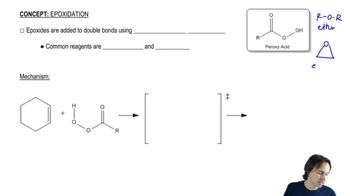
Epoxides are three-membered cyclic ethers characterized by a highly strained ring structure. This strain makes them reactive intermediates in organic reactions, particularly in nucleophilic addition reactions. The oxygen atom in the epoxide contributes to the ring's reactivity, allowing nucleophiles to attack the less hindered carbon atom adjacent to the oxygen.
Recommended video:
Guided course
02:19
General properties of epoxidation.

Nucleophilic Addition

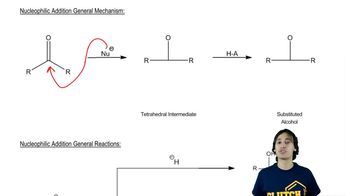
Nucleophilic addition is a fundamental reaction mechanism in organic chemistry where a nucleophile attacks an electrophilic center, leading to the formation of a new bond. In the case of epoxides, nucleophiles can open the strained ring by attacking one of the carbon atoms, resulting in the formation of an alcohol or other functional groups depending on the nucleophile used.
Recommended video:
Guided course
08:27
Nucleophilic Addition

Regioselectivity

Regioselectivity refers to the preference of a chemical reaction to occur at one site over another in a molecule. In epoxide addition reactions, the regioselectivity is influenced by steric and electronic factors, determining which carbon atom the nucleophile will attack. Understanding regioselectivity is crucial for predicting the major product of the reaction.
Recommended video:
Guided course
05:09
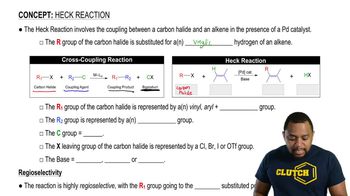
Heck Reaction