Ch. 16 - Metals in Organic Chemistry
Mullins - Organic Chemistry: A Learner Centered Approach 1st Edition
Mullins1st EditionOrganic Chemistry: A Learner Centered ApproachISBN: 9780137566471Not the one you use?Change textbook
Chapter 15, Problem 31a

Predict the product of the following Sonogashira coupling reactions.
(a) Chemical structure diagram illustrating a Sonogashira coupling reaction with reactants and conditions labeled.

Verified step by step guidance
1
Identify the reactants involved in the Sonogashira coupling reaction. The reactants are a diiodobenzene derivative and an alkyne with a terminal hydrogen and an ester group (CO2Me).
Understand the role of the catalysts and base in the reaction. The reaction uses Pd(PPh3)4 as the palladium catalyst, CuI as the copper co-catalyst, and iPr2NH as the base. These components facilitate the coupling of the alkyne to the aryl iodide.
Recognize the mechanism of the Sonogashira coupling. The palladium catalyst first undergoes oxidative addition with the aryl iodide, forming a palladium-aryl complex. The copper co-catalyst activates the terminal alkyne, allowing it to form a copper-acetylide complex.
The palladium-aryl complex and the copper-acetylide complex then undergo transmetalation, where the acetylide group is transferred to the palladium, forming a palladium-acetylide complex.
Finally, reductive elimination occurs, where the palladium-acetylide complex forms a new carbon-carbon bond between the aryl group and the alkyne, resulting in the coupled product. Since there are two equivalents of the alkyne, both iodine groups on the benzene ring will be replaced by the alkyne, forming a bis-alkyne product.

Verified video answer for a similar problem:

This video solution was recommended by our tutors as helpful for the problem above.
Video duration:
3m
Was this helpful?

Key Concepts

Here are the essential concepts you must grasp in order to answer the question correctly.

Sonogashira Coupling

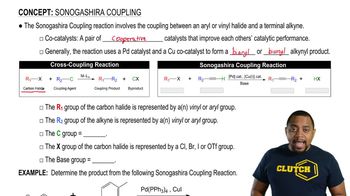
The Sonogashira coupling is a cross-coupling reaction that involves the coupling of an aryl or vinyl halide with an alkyne in the presence of a palladium catalyst and a base. This reaction is widely used in organic synthesis to form carbon-carbon bonds, particularly in the construction of complex molecules and materials.
Recommended video:
Guided course
02:54
Sonogashira Coupling Reaction

Palladium Catalysis

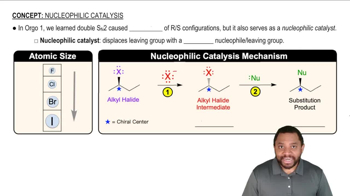
Palladium catalysis is a key component in many cross-coupling reactions, including the Sonogashira reaction. Palladium serves as a catalyst that facilitates the formation of the carbon-carbon bond by activating the halide and the alkyne, allowing for the efficient coupling of these two components under mild conditions.
Recommended video:
2:31
Nucleophilic Catalysis Concept 1

Reaction Mechanism

Understanding the reaction mechanism of the Sonogashira coupling is essential for predicting the products. The mechanism typically involves oxidative addition of the halide to the palladium, followed by alkyne coordination, and finally reductive elimination to form the coupled product. Analyzing the mechanism helps in anticipating the regioselectivity and stereochemistry of the final product.
Recommended video:
Guided course
02:16
Heck Reaction Mechanism