Ch. 17 - Carbonyl Addition Reactions: Aldehydes and Ketones
Mullins - Organic Chemistry: A Learner Centered Approach 1st Edition
Mullins1st EditionOrganic Chemistry: A Learner Centered ApproachISBN: 9780137566471Not the one you use?Change textbook
Chapter 16, Problem 64

In lieu of quenching the product of Grignard addition to a carbonyl with acid, alkyl halides can be added directly to generate ether products. Predict the product and show the mechanism of this process.
Grignard reagent reacts with carbonyl, followed by alkyl chloride addition, forming ether. Mechanism steps shown.

Verified step by step guidance
1
Step 1: Begin by understanding the Grignard reaction. A Grignard reagent is typically formed by reacting an alkyl halide with magnesium in dry ether, resulting in a highly reactive organomagnesium compound. This reagent is used to attack electrophilic centers, such as carbonyl groups.
Step 2: Consider the reaction between the Grignard reagent and a carbonyl compound. The Grignard reagent acts as a nucleophile, attacking the electrophilic carbon of the carbonyl group, leading to the formation of an alkoxide intermediate.
Step 3: Instead of quenching the alkoxide intermediate with acid, introduce an alkyl halide to the reaction mixture. The alkoxide can act as a nucleophile, attacking the alkyl halide in a nucleophilic substitution reaction, typically an SN2 mechanism, to form an ether.
Step 4: Illustrate the mechanism of the reaction. The alkoxide ion attacks the electrophilic carbon of the alkyl halide, displacing the halide ion and forming the ether product. Use curved arrows to show the movement of electrons during this process.
Step 5: Predict the final product. The reaction results in the formation of an ether, where the alkyl group from the Grignard reagent is bonded to the oxygen atom, and the alkyl group from the alkyl halide is bonded to the other side of the oxygen atom, completing the ether structure.

Verified video answer for a similar problem:

This video solution was recommended by our tutors as helpful for the problem above.
Was this helpful?

Key Concepts

Here are the essential concepts you must grasp in order to answer the question correctly.

Grignard Reagents

Grignard reagents are organomagnesium compounds typically represented as RMgX, where R is an organic group and X is a halogen. They are highly reactive and used to form carbon-carbon bonds by attacking electrophilic centers, such as carbonyl groups, in organic synthesis.
Recommended video:
Guided course
02:12
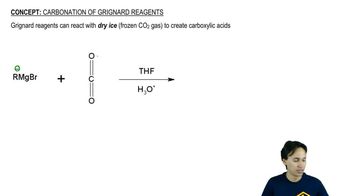
Carbonation of Grignard Reagents

Ether Formation

Ether formation involves the creation of an ether linkage (R-O-R') through nucleophilic substitution or addition reactions. In the context of Grignard reactions, ethers can be formed by reacting the Grignard reagent with alkyl halides, where the alkyl group replaces the halide, resulting in an ether product.
Recommended video:
Guided course
04:22
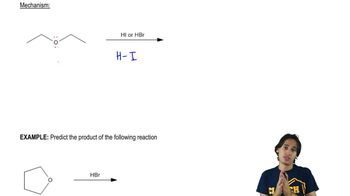
How to predict the products of Ether Cleavage.

Reaction Mechanism

A reaction mechanism outlines the step-by-step process by which reactants transform into products, detailing the movement of electrons and changes in molecular structure. For Grignard reactions, the mechanism typically involves nucleophilic attack on a carbonyl carbon, followed by protonation or substitution to yield the final product.
Recommended video:
Guided course
02:16
Heck Reaction Mechanism