Ch. 17 - Carbonyl Addition Reactions: Aldehydes and Ketones
Mullins - Organic Chemistry: A Learner Centered Approach 1st Edition
Mullins1st EditionOrganic Chemistry: A Learner Centered ApproachISBN: 9780137566471Not the one you use?Change textbook
Chapter 16, Problem 22a

Suggest a carbonyl to react with NaCN/HCN to produce the following cyanohydrins.
(a) Reaction scheme showing NaCN and HCN converting a carbonyl compound into a cyanohydrin with hydroxyl and cyano groups.

Verified step by step guidance
1
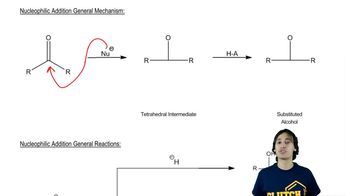
Step 1: Understand the reaction mechanism. The reaction between a carbonyl compound and NaCN/HCN involves the nucleophilic addition of the cyanide ion (CN⁻) to the carbonyl carbon, forming a cyanohydrin.
Step 2: Identify the structure of the cyanohydrin product. Analyze the given image to determine the structure of the cyanohydrin, focusing on the functional groups and the carbon skeleton.
Step 3: Determine the carbonyl precursor. Since cyanohydrins are formed by the addition of CN⁻ to the carbonyl carbon, the carbonyl compound should have the same carbon skeleton as the cyanohydrin minus the CN group.
Step 4: Consider the stereochemistry. If the cyanohydrin has chiral centers, consider the stereochemistry of the starting carbonyl compound, as it can influence the stereochemistry of the product.
Step 5: Suggest the carbonyl compound. Based on the analysis, suggest a carbonyl compound (either an aldehyde or ketone) that would react with NaCN/HCN to yield the cyanohydrin with the desired structure.

Verified video answer for a similar problem:

This video solution was recommended by our tutors as helpful for the problem above.
Video duration:
2m
Was this helpful?

Key Concepts

Here are the essential concepts you must grasp in order to answer the question correctly.

Carbonyl Compounds

Carbonyl compounds, characterized by the presence of a carbon-oxygen double bond (C=O), include aldehydes and ketones. They are highly reactive due to the electrophilic nature of the carbon atom, making them susceptible to nucleophilic attack. Understanding the structure and reactivity of carbonyls is essential for predicting their behavior in reactions, such as those with nucleophiles like cyanide.
Recommended video:
Guided course
01:40
Defining meso compounds.

Nucleophilic Addition

Nucleophilic addition is a fundamental reaction mechanism in organic chemistry where a nucleophile attacks an electrophilic carbon atom, leading to the formation of a new bond. In the case of carbonyl compounds, nucleophiles such as NaCN or HCN can add to the carbonyl carbon, resulting in the formation of cyanohydrins. This mechanism is crucial for understanding how to synthesize various organic compounds from carbonyl precursors.
Recommended video:
Guided course
08:27
Nucleophilic Addition

Cyanohydrins

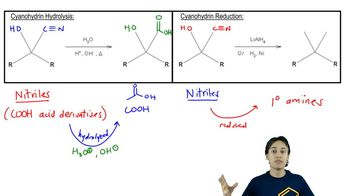
Cyanohydrins are organic compounds formed by the addition of hydrogen cyanide (HCN) to carbonyl compounds, resulting in a hydroxyl group (-OH) and a cyano group (-CN) attached to the same carbon atom. They are important intermediates in organic synthesis and can be further transformed into various functional groups. Recognizing the structure and properties of cyanohydrins is vital for predicting their reactivity and potential applications in organic chemistry.
Recommended video:
Guided course
02:36
Nitrile Reduction