Ch. 17 - Carbonyl Addition Reactions: Aldehydes and Ketones
Mullins - Organic Chemistry: A Learner Centered Approach 1st Edition
Mullins1st EditionOrganic Chemistry: A Learner Centered ApproachISBN: 9780137566471Not the one you use?Change textbook
Chapter 16, Problem 56a

The following molecules were named incorrectly according to IUPAC nomenclature. Give the correct name of these compounds.
(a) 3-oxo-5-methylhexan-2-ol

Verified step by step guidance
1
Step 1: Identify the longest carbon chain in the molecule. The longest chain will determine the base name of the compound. In this case, the longest chain is hexane, which consists of six carbon atoms.
Step 2: Determine the correct numbering of the carbon atoms in the chain. Number the chain from the end nearest to the highest priority functional group. Here, the hydroxyl group (-OH) has higher priority than the ketone group (oxo), so start numbering from the end closest to the hydroxyl group.
Step 3: Identify and name the substituents and functional groups. The molecule has a hydroxyl group (-OH) and a ketone group (oxo). The hydroxyl group is on the second carbon, and the ketone group is on the third carbon. Additionally, there is a methyl group on the fifth carbon.
Step 4: Assemble the name by placing the substituents and functional groups in alphabetical order, followed by the base name of the longest chain. The correct name should reflect the priority of the functional groups and the correct numbering of the chain.
Step 5: Ensure the name follows IUPAC rules, which prioritize the hydroxyl group over the ketone group. The correct name should be structured as: 2-hydroxy-5-methylhexan-3-one.

Verified video answer for a similar problem:

This video solution was recommended by our tutors as helpful for the problem above.
Was this helpful?

Key Concepts

Here are the essential concepts you must grasp in order to answer the question correctly.

IUPAC Nomenclature

IUPAC nomenclature is a systematic method of naming organic chemical compounds as recommended by the International Union of Pure and Applied Chemistry. It provides a standardized way to name molecules so that chemists can easily communicate and understand the structure of a compound. The rules involve identifying the longest carbon chain, numbering the chain to give substituents the lowest possible numbers, and naming substituents and functional groups according to priority.
Recommended video:
Guided course
03:43
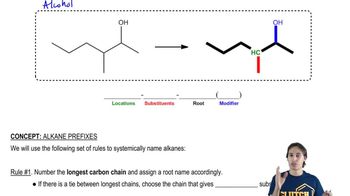
The different parts of an IUPAC name

Functional Group Priority

In IUPAC nomenclature, functional groups are assigned a priority order which affects the numbering of the carbon chain and the suffix used in the compound's name. The group with the highest priority is given the lowest possible number and often dictates the suffix of the compound's name. For example, ketones have a higher priority than alcohols, so in a molecule containing both, the ketone group will influence the main chain numbering and suffix.
Recommended video:
Guided course
02:36
Identifying Functional Groups

Locants in Nomenclature

Locants are numbers used in chemical nomenclature to indicate the position of substituents, functional groups, or double/triple bonds on the main carbon chain. Correctly assigning locants is crucial for accurately naming a compound, as it ensures that the structure is unambiguously described. The goal is to assign the lowest possible numbers to the highest priority groups or substituents, following the IUPAC rules.
Recommended video:
4:02
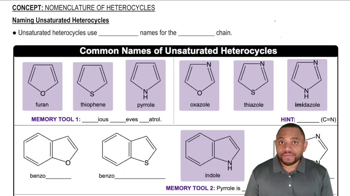
Nomenclature of Heterocycles Concept 2