Ch. 18 - Nucleophilic Acyl Substitution I: Carboxylic Acids
Mullins - Organic Chemistry: A Learner Centered Approach 1st Edition
Mullins1st EditionOrganic Chemistry: A Learner Centered ApproachISBN: 9780137566471Not the one you use?Change textbook
Chapter 17, Problem 3b

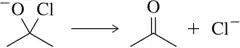
Would you expect ∆S to be greater than, less than, or equal to zero in the following reactions?
(b) Chemical reaction diagram showing the transformation of a chlorinated compound into a carbonyl compound and chloride ion.

Verified step by step guidance
1
Step 1: Understand the concept of entropy (∆S). Entropy is a measure of the disorder or randomness in a system. A positive ∆S indicates an increase in disorder, while a negative ∆S indicates a decrease in disorder.
Step 2: Analyze the type of reaction given. For example, if the reaction involves breaking a single molecule into multiple smaller molecules, the entropy typically increases (∆S > 0). Conversely, if multiple molecules combine to form a single molecule, the entropy typically decreases (∆S < 0).
Step 3: Consider the physical states of the reactants and products. Gases have higher entropy than liquids or solids. If the reaction produces more gas molecules than it consumes, ∆S is likely positive. If it consumes more gas molecules than it produces, ∆S is likely negative.
Step 4: Evaluate the specific reaction provided. Count the number of molecules on the reactant and product sides, and note their physical states (solid, liquid, gas). This will help determine whether the system's disorder increases or decreases.
Step 5: Conclude whether ∆S is greater than, less than, or equal to zero based on the analysis of molecular count and physical states. Provide reasoning for your conclusion.

Verified video answer for a similar problem:

This video solution was recommended by our tutors as helpful for the problem above.
Video duration:
1m
Was this helpful?

Key Concepts

Here are the essential concepts you must grasp in order to answer the question correctly.

Entropy (∆S)

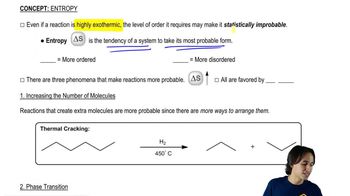
Entropy, denoted as ∆S, is a measure of the disorder or randomness in a system. In chemical reactions, changes in entropy can indicate whether the products are more or less disordered than the reactants. A positive ∆S suggests an increase in disorder, while a negative ∆S indicates a decrease. Understanding how molecular arrangements change during reactions is crucial for predicting entropy changes.
Recommended video:
Guided course
02:46
Explaining what entropy is.

Reaction Types and Entropy

Different types of reactions can influence entropy changes. For example, reactions that produce gas from solids or liquids typically result in an increase in entropy due to the greater freedom of movement of gas molecules. Conversely, reactions that involve the formation of solids from gases or liquids may lead to a decrease in entropy. Recognizing the nature of the reactants and products helps in assessing the expected sign of ∆S.
Recommended video:
Guided course
02:46
Explaining what entropy is.

Thermodynamic Principles

Thermodynamics provides the framework for understanding energy changes in chemical reactions, including entropy. The Second Law of Thermodynamics states that the total entropy of an isolated system can never decrease over time. This principle helps predict whether a reaction will be spontaneous and how entropy changes relate to the overall energy balance, guiding the expectation of whether ∆S will be positive, negative, or zero.
Recommended video:
Guided course
08:51
Kinetic vs. Thermodynamic Control