Ch. 19 - Nucleophilic Acyl Substitution II: Carboxylic Acid Derivatives
Mullins - Organic Chemistry: A Learner Centered Approach 1st Edition
Mullins1st EditionOrganic Chemistry: A Learner Centered ApproachISBN: 9780137566471Not the one you use?Change textbook
Chapter 18, Problem 38

Predict the product of the multistep synthesis reaction shown.
Cyclopentanol reacts with H2CrO4, SOCl2, isopropylamine, and LiAlH4 in THF in a multistep synthesis.

Verified step by step guidance
1
Step 1: Identify the starting material and the reagents used in each step of the synthesis. This will help you understand the transformations that occur at each stage.
Step 2: Analyze the first reaction step. Determine the functional group transformations or bond formations that occur with the given reagents. Consider mechanisms such as nucleophilic substitution, elimination, or addition reactions.
Step 3: For each subsequent step, consider the product of the previous step as the new starting material. Apply the reagents and conditions to predict the next transformation. Pay attention to stereochemistry and regiochemistry if applicable.
Step 4: Continue this process for each step in the synthesis, ensuring that you account for all functional group changes and any rearrangements or intermediate formations.
Step 5: Once you have predicted the product for the final step, review the entire sequence to ensure that each transformation logically follows from the previous one and that the final product is consistent with the expected outcome of the synthesis.

Verified video answer for a similar problem:

This video solution was recommended by our tutors as helpful for the problem above.
Video duration:
4m
Was this helpful?

Key Concepts

Here are the essential concepts you must grasp in order to answer the question correctly.

Reaction Mechanisms

Understanding reaction mechanisms is crucial for predicting the products of a multistep synthesis. A reaction mechanism details the step-by-step sequence of elementary reactions by which overall chemical change occurs. It involves identifying intermediates, transition states, and the movement of electrons, which helps in determining the final product.
Recommended video:
Guided course
02:16
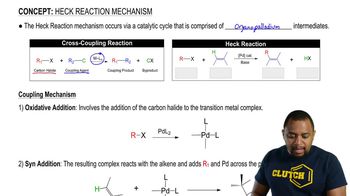
Heck Reaction Mechanism

Functional Group Transformations

Functional group transformations are essential in multistep synthesis as they involve converting one functional group into another, which can drastically change the reactivity and properties of a molecule. Recognizing these transformations allows chemists to plan and predict the sequence of reactions needed to synthesize a desired compound.
Recommended video:
Guided course
02:36
Identifying Functional Groups

Retrosynthetic Analysis

Retrosynthetic analysis is a strategy used to simplify the process of designing a synthesis by breaking down complex molecules into simpler precursor structures. By working backward from the target molecule, chemists can identify key intermediates and the necessary reactions to construct the final product, making it a vital tool in multistep synthesis.
Recommended video:
Guided course
01:22
Retrosynthesis