Ch. 2 - General Chemistry Translated: Finding the Electrons
Mullins - Organic Chemistry: A Learner Centered Approach 1st Edition
Mullins1st EditionOrganic Chemistry: A Learner Centered ApproachISBN: 9780137566471Not the one you use?Change textbook
Chapter 1, Problem 4a

How many valence shell electrons do each of the following elements contain? How many new bonds can each form?
(a) C

Verified step by step guidance
1
Step 1: Identify the group number of the element Carbon (C) in the periodic table. Carbon is in Group 14 (or Group IV in older notations).
Step 2: Determine the number of valence electrons for Carbon. The group number corresponds to the number of valence electrons for main group elements. Therefore, Carbon has 4 valence electrons.
Step 3: Understand the bonding capacity of Carbon. The number of new bonds an element can form is determined by the number of unpaired electrons it can share to achieve a full octet (8 electrons in its valence shell).
Step 4: Calculate the bonding capacity of Carbon. Since Carbon has 4 valence electrons, it needs 4 more electrons to complete its octet. Thus, Carbon can form 4 new covalent bonds.
Step 5: Summarize the findings. Carbon has 4 valence electrons and can form 4 new bonds to achieve a stable electronic configuration.

Verified video answer for a similar problem:

This video solution was recommended by our tutors as helpful for the problem above.
Video duration:
2m
Was this helpful?

Key Concepts

Here are the essential concepts you must grasp in order to answer the question correctly.

Valence Electrons

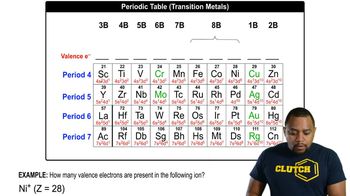
Valence electrons are the electrons located in the outermost shell of an atom. They play a crucial role in chemical bonding, as they are the electrons involved in forming bonds with other atoms. For carbon (C), which is in group 14 of the periodic table, there are four valence electrons, allowing it to form a variety of bonds.
Recommended video:
Guided course
03:40
Valence Electrons of Transition Metals

Bond Formation

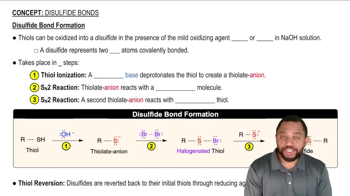
Bond formation refers to the process by which atoms connect to create molecules. The number of bonds an atom can form is determined by its valence electrons. Carbon can form four covalent bonds by sharing its four valence electrons with other atoms, enabling it to create stable compounds like methane (CH4) and many organic molecules.
Recommended video:
2:01
Disulfide Bonds Concept 1

Covalent Bonds

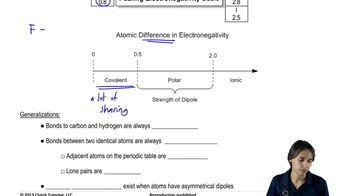
Covalent bonds are a type of chemical bond where two atoms share one or more pairs of valence electrons. This sharing allows each atom to attain a full outer shell, achieving greater stability. In the case of carbon, it typically forms single, double, or even triple covalent bonds with other elements, depending on the number of shared electron pairs.
Recommended video:
Guided course
11:33
Differences between ionic, polar and covalent bonds