Textbook Question
Looking ahead in Chapter 4, we explain that molecules like CH3+ are Lewis acids or electron pair acceptors. Into which orbital would the new electron pair go?
1097
views

 Mullins 1st EditionCh. 2 - General Chemistry Translated: Finding the ElectronsProblem 81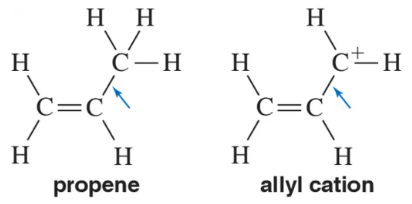
 Verified step by step guidance
 06:00
06:00
 03:43
03:43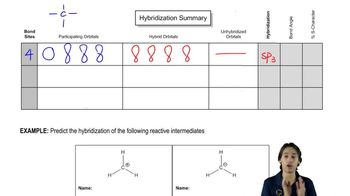 10:43
10:43Looking ahead in Chapter 4, we explain that molecules like CH3+ are Lewis acids or electron pair acceptors. Into which orbital would the new electron pair go?
The C―H σ bond length in ethane is 1.09 Å. The C―H σ bond in ethene is 1.07 Å. Explain.
There is free rotation around the C―C bond in ethane. There is an extremely high barrier to rotation around the C=C bond in in ethene. Explain.
The C―N bond in the following amide is much stronger than the C―N bond in the amine. Explain.
Carbon dioxide (CO2) has no dipole moment (μ = 0 D). The related molecule sulfur dioxide (SO2) does have a dipole moment (μ = 1.6 D) Explain this observation.
In comparison to CH3+ in Assessment 2.82, the related molecule H3O+ is not a Lewis acid at oxygen. Why?