Ch. 2 - General Chemistry Translated: Finding the Electrons
Mullins - Organic Chemistry: A Learner Centered Approach 1st Edition
Mullins1st EditionOrganic Chemistry: A Learner Centered ApproachISBN: 9780137566471Not the one you use?Change textbook
Chapter 1, Problem 87

In comparison to CH3- in Assessment 2.86, the related molecule BH4- is itself not a Lewis base at boron. Why?

Verified step by step guidance
1
Understand the concept of a Lewis base: A Lewis base is a species that donates a pair of electrons to form a covalent bond. This requires the presence of a lone pair of electrons on the atom in question.
Analyze the structure of CH₃⁻: In CH₃⁻, the carbon atom has a lone pair of electrons, making it capable of donating this pair and acting as a Lewis base.
Examine the structure of BH₄⁻: In BH₄⁻, the boron atom is surrounded by four hydrogen atoms, forming a tetrahedral structure. Boron in this case has a full octet due to the bonding with the hydrogens.
Determine the availability of lone pairs on boron in BH₄⁻: Unlike CH₃⁻, boron in BH₄⁻ does not have a lone pair of electrons. All of its valence electrons are involved in bonding with the hydrogen atoms.
Conclude why BH₄⁻ is not a Lewis base: Since boron in BH₄⁻ lacks a lone pair of electrons to donate, it cannot act as a Lewis base, even though the molecule carries a negative charge. This is a key distinction from CH₃⁻.

Verified video answer for a similar problem:

This video solution was recommended by our tutors as helpful for the problem above.
Was this helpful?

Key Concepts

Here are the essential concepts you must grasp in order to answer the question correctly.

Lewis Acids and Bases

Lewis acids are electron pair acceptors, while Lewis bases are electron pair donors. In the context of boron and carbon compounds, understanding these definitions is crucial for determining the reactivity and classification of molecules. For instance, CH₃⁻ is a Lewis base because it can donate an electron pair, whereas BH₄⁻ does not behave as a Lewis base due to the electron deficiency of boron.
Recommended video:
Guided course
02:49
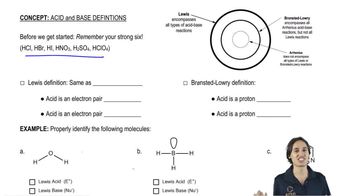
The Lewis definition of acids and bases.

Electron Deficiency in Boron

Boron is an electron-deficient element, typically forming three covalent bonds and having an incomplete octet. This characteristic makes boron less likely to donate electron pairs, which is a key trait of Lewis bases. In BH₄⁻, the boron atom is surrounded by four hydrogens, stabilizing its electron configuration but not allowing it to act as a base.
Recommended video:
Guided course
03:54
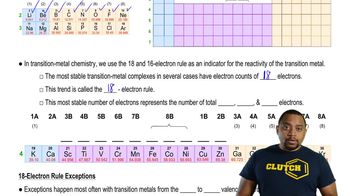
The 18 and 16 Electron Rule

Resonance and Stability

Resonance refers to the delocalization of electrons across multiple structures, which can stabilize a molecule. In the case of BH₄⁻, the resonance structures do not allow for the boron atom to effectively donate an electron pair, as the overall stability of the molecule is maintained without it acting as a Lewis base. This contrasts with CH₃⁻, where the carbon can easily donate its lone pair.
Recommended video:
Guided course
03:43
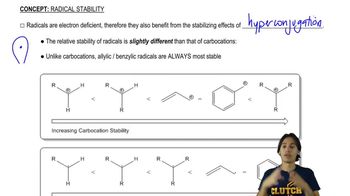
The radical stability trend.