Ch. 20 - Enolates: Carbonyl Addition and Substitution
Mullins - Organic Chemistry: A Learner Centered Approach 1st Edition
Mullins1st EditionOrganic Chemistry: A Learner Centered ApproachISBN: 9780137566471Not the one you use?Change textbook
Chapter 19, Problem 72a

Identify the enolate(s) that would form on treatment of each of the following carbonyls with base. [When there are two possibilities, draw both.]
(a) Chemical structure of a cyclohexanone with a carbonyl group and an attached alkyl chain.

Verified step by step guidance
1
Identify the alpha carbon(s) adjacent to the carbonyl group in the given ketone structure. The alpha carbon is the one directly connected to the carbonyl carbon.
Determine the number of alpha hydrogens available for deprotonation. In this structure, there are two alpha carbons, each with hydrogens that can be deprotonated.
Consider the base-induced deprotonation of the alpha hydrogen(s) to form the enolate ion. The base will remove an alpha hydrogen, resulting in the formation of a carbanion at the alpha carbon.
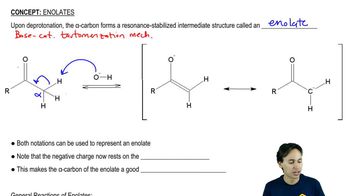
Draw the resonance structures of the enolate ion. The negative charge on the alpha carbon can be delocalized onto the oxygen atom of the carbonyl group, forming a resonance-stabilized enolate.
Since there are two alpha carbons, draw both possible enolates. Each enolate will have a different alpha carbon deprotonated, leading to two distinct enolate structures.

Verified video answer for a similar problem:

This video solution was recommended by our tutors as helpful for the problem above.
Video duration:
2m
Was this helpful?

Key Concepts

Here are the essential concepts you must grasp in order to answer the question correctly.

Enolate Formation

Enolates are formed when a carbonyl compound, such as a ketone or aldehyde, is treated with a strong base. The base abstracts a proton from the alpha carbon (the carbon adjacent to the carbonyl), resulting in the formation of a resonance-stabilized anion. This process is crucial for understanding nucleophilic addition reactions and the reactivity of carbonyl compounds.
Recommended video:
Guided course
02:26
Formation of Enolates

Resonance Stabilization

Resonance stabilization refers to the delocalization of electrons across multiple structures, which lowers the energy of the molecule. In the case of enolates, the negative charge can be distributed between the alpha carbon and the carbonyl carbon, creating resonance forms that enhance the stability of the enolate ion. This concept is essential for predicting the reactivity and stability of intermediates in organic reactions.
Recommended video:
Guided course
03:43
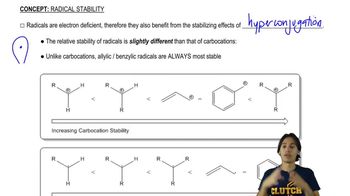
The radical stability trend.

Base Strength and Selectivity

The choice of base in enolate formation affects both the rate of reaction and the type of enolate formed. Strong bases, such as LDA or sodium hydride, can deprotonate carbonyl compounds effectively, while weaker bases may lead to less stable or less reactive enolates. Understanding the strength and selectivity of bases is vital for predicting the outcome of reactions involving carbonyl compounds.
Recommended video:
2:56
Base Pairing Concept 1