Ch. 20 - Enolates: Carbonyl Addition and Substitution
Mullins - Organic Chemistry: A Learner Centered Approach 1st Edition
Mullins1st EditionOrganic Chemistry: A Learner Centered ApproachISBN: 9780137566471Not the one you use?Change textbook
Chapter 19, Problem 18b

Specify which in each pair is the harder Lewis acid. Justify your choice beyond just looking at Table 20.2.
(b) Li+ vs. Na+

Verified step by step guidance
1
Step 1: Recall the definition of a Lewis acid. A Lewis acid is a species that can accept an electron pair. Hard Lewis acids are typically small, highly charged, and have low polarizability.
Step 2: Compare the two ions, Li+ and Na+. Both are alkali metal cations, but they differ in size and charge density. Li+ is smaller in size compared to Na+, which means it has a higher charge density.
Step 3: Higher charge density makes Li+ a stronger Lewis acid because it can attract electron pairs more effectively due to its concentrated positive charge.
Step 4: Consider polarizability. Li+ is less polarizable than Na+ because of its smaller size and tighter electron cloud. This characteristic aligns with the properties of hard acids, making Li+ harder than Na+.
Step 5: Justify the choice using the table provided. Both Li+ and Na+ are listed under hard acids, but Li+ is harder due to its smaller ionic radius and higher charge density, which are key factors in determining the hardness of a Lewis acid.

Verified video answer for a similar problem:

This video solution was recommended by our tutors as helpful for the problem above.
Was this helpful?

Key Concepts

Here are the essential concepts you must grasp in order to answer the question correctly.

Lewis Acids and Bases

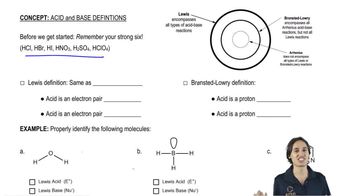
Lewis acids are species that can accept an electron pair, while Lewis bases are those that can donate an electron pair. This concept is fundamental in understanding acid-base reactions in organic chemistry, as it expands the definition beyond protons (Brønsted acids) to include a wider range of chemical interactions. The strength of a Lewis acid is often determined by its ability to stabilize the negative charge of the electron pair it accepts.
Recommended video:
Guided course
02:49
The Lewis definition of acids and bases.

Hard and Soft Acids and Bases (HSAB) Theory

The HSAB theory categorizes acids and bases as 'hard' or 'soft' based on their charge density and polarizability. Hard acids, like Li<sup>+</sup>, have small size and high charge density, making them less polarizable and more stable in reactions with hard bases. In contrast, soft acids, such as Na<sup>+</sup>, are larger and more polarizable, favoring interactions with soft bases. This classification helps predict the stability and reactivity of acid-base pairs.
Recommended video:
Guided course
02:49
The Lewis definition of acids and bases.

Comparative Strength of Lewis Acids

To determine which Lewis acid is stronger between two candidates, one must consider factors such as charge density, size, and the ability to stabilize the resulting complex. In the case of Li<sup>+</sup> versus Na<sup>+</sup>, Li<sup>+</sup> is a harder acid due to its smaller ionic radius and higher charge density, making it more effective at accepting electron pairs compared to the larger, softer Na<sup>+</sup>. This comparative analysis is crucial for understanding their reactivity in various chemical environments.
Recommended video:
Guided course
02:41
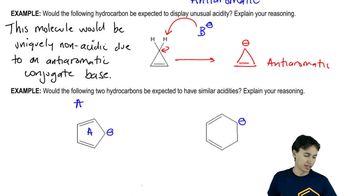
Comparing hydrocarbon acidity