
Ch. 21 - Conjugated Systems I: Stability and Addition Reactions
Mullins - Organic Chemistry: A Learner Centered Approach 1st Edition
Mullins1st EditionOrganic Chemistry: A Learner Centered ApproachISBN: 9780137566471Not the one you use?Change textbook
Chapter 20, Problem 72

The following reaction was used in the synthesis of aculeatin A, a natural product that is active against KB cell lines. Although it only worked under acidic conditions, a mechanism can be drawn where the reaction might proceed under basic conditions. Suggest this mechanism (J. Org. Chem. 2014, 79, 1498–1504). [The most acidic proton is indicated . . . and number your carbons!]
Chemical reaction diagram illustrating the Michael Addition mechanism for synthesizing aculeatin A, highlighting the most acidic proton.

Verified step by step guidance
1
Step 1: Identify the most acidic proton in the starting material. The hydroxyl group (OH) indicated by the arrow is the most acidic proton due to its ability to donate a proton and form a stabilized conjugate base.
Step 2: Under basic conditions, the base (KOt-Bu) will deprotonate the hydroxyl group, forming an alkoxide ion. This alkoxide ion is a strong nucleophile and can participate in subsequent reactions.
Step 3: The alkoxide ion can attack the carbonyl carbon of the ester group in an intramolecular nucleophilic attack. This forms a new bond between the oxygen of the alkoxide and the carbonyl carbon, leading to the formation of a cyclic intermediate.
Step 4: The cyclic intermediate undergoes rearrangement or elimination to form the final product. The driving force for this reaction is the formation of a stable lactone ring structure, which is energetically favorable.
Step 5: Number the carbons in the starting material to track the transformation. Assign numbers to the carbons in the ring and side chains systematically, ensuring clarity in the mechanism and product formation.

Verified video answer for a similar problem:

This video solution was recommended by our tutors as helpful for the problem above.
Was this helpful?

Key Concepts

Here are the essential concepts you must grasp in order to answer the question correctly.

Acid-Base Chemistry

Understanding acid-base chemistry is crucial for analyzing reactions that occur under different pH conditions. In organic reactions, acids can donate protons (H+) while bases can accept them. The nature of the solvent and the presence of acidic or basic conditions can significantly influence the reaction pathway and the stability of intermediates.
Recommended video:
Guided course
02:49
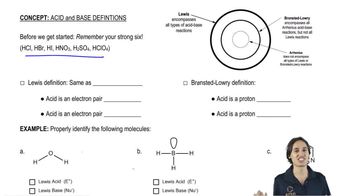
The Lewis definition of acids and bases.

Reaction Mechanisms

A reaction mechanism outlines the step-by-step process by which reactants transform into products. It includes the identification of intermediates, transition states, and the order of bond-breaking and bond-forming events. Proposing a mechanism under basic conditions requires understanding how the reaction might differ from the acidic pathway, including the role of nucleophiles and electrophiles.
Recommended video:
Guided course
02:16
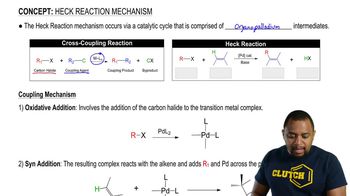
Heck Reaction Mechanism

Natural Product Synthesis

Natural product synthesis involves the chemical processes used to create complex organic molecules found in nature. This often requires specific conditions to achieve desired reactivity and selectivity. In the case of aculeatin A, recognizing the structural features and functional groups involved is essential for proposing a viable synthetic route, especially when considering alternative reaction conditions.
Recommended video:
1:16
Synthesis of Amino Acids: Strecker Synthesis Example 1