Ch. 21 - Conjugated Systems I: Stability and Addition Reactions
Mullins - Organic Chemistry: A Learner Centered Approach 1st Edition
Mullins1st EditionOrganic Chemistry: A Learner Centered ApproachISBN: 9780137566471Not the one you use?Change textbook
Chapter 20, Problem 51a

How many 𝝅 electrons are involved in the conjugated system for each of the following molecules?
(a) Chemical structure of a methoxy-substituted cyclohexadienone with two conjugated double bonds and a ketone group.

Verified step by step guidance
1
Identify the conjugated system in the molecule. A conjugated system typically consists of alternating single and multiple bonds, which allows for the delocalization of π electrons.
Count the number of π bonds in the conjugated system. Each π bond contributes two π electrons to the system.
Consider any lone pairs that may be part of the conjugated system. Lone pairs can also contribute π electrons if they are in p orbitals and can overlap with the π system.
Sum the π electrons from the π bonds and any contributing lone pairs to determine the total number of π electrons in the conjugated system.
Verify the structure to ensure all π electrons have been accounted for and that the system is indeed conjugated, meaning the π electrons are delocalized over the entire system.

Verified video answer for a similar problem:

This video solution was recommended by our tutors as helpful for the problem above.
Was this helpful?

Key Concepts

Here are the essential concepts you must grasp in order to answer the question correctly.

Pi Electrons

Pi (Ļ€) electrons are the electrons found in the p orbitals that participate in pi bonds, which are formed by the sideways overlap of adjacent p orbitals. These electrons are delocalized over the atoms involved in the pi bond, contributing to the molecule's conjugation and stability. Understanding the number of pi electrons is crucial for analyzing the electronic structure of conjugated systems.
Recommended video:
Guided course
01:33
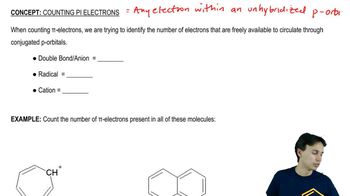
Counting pi electrons

Conjugated Systems

A conjugated system in organic chemistry refers to a sequence of alternating single and multiple bonds, typically double bonds, which allows for the delocalization of pi electrons across the system. This delocalization leads to increased stability and can affect the molecule's color, reactivity, and other properties. Identifying conjugated systems is essential for determining the number of pi electrons involved.
Recommended video:
Guided course
03:27
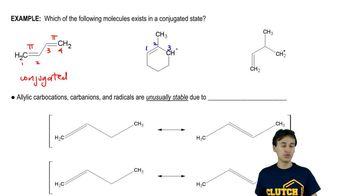
Conjugated states

Hückel's Rule

Hückel's Rule is a principle used to determine the aromaticity of a planar, cyclic, conjugated molecule. According to this rule, a molecule is aromatic if it has (4n + 2) pi electrons, where n is a non-negative integer. This rule helps in identifying stable aromatic systems and is useful for understanding the behavior of pi electrons in conjugated systems.
Recommended video:
Guided course
03:54
The 18 and 16 Electron Rule