Ch. 21 - Conjugated Systems I: Stability and Addition Reactions
Mullins - Organic Chemistry: A Learner Centered Approach 1st Edition
Mullins1st EditionOrganic Chemistry: A Learner Centered ApproachISBN: 9780137566471Not the one you use?Change textbook
Chapter 20, Problem 58

In Chapter 9, electron-rich alkenes were oxidized under acidic conditions with mCPBA. Conjugated alkenes can be oxidized using the same reagent, but under basic conditions. Suggest a mechanism for this reaction. [Think about what is electron-rich and what is electron-poor in the reaction. Also, identify the bonds formed and broken.]
Chemical reaction diagram showing epoxidation of alkenes with mCPBA under basic conditions, illustrating reactants and products.

Verified step by step guidance
1
Identify the key reactants: The reaction involves a conjugated alkene and mCPBA (meta-chloroperoxybenzoic acid) under basic conditions. mCPBA is an oxidizing agent that typically transfers an oxygen atom to the substrate.
Analyze the electron density: Conjugated alkenes have delocalized π-electrons, making them electron-rich. Under basic conditions, the peroxyacid (mCPBA) deprotonates to form a peroxy anion, which is electron-poor and acts as the electrophile.
Propose the first step of the mechanism: The electron-rich π-system of the conjugated alkene attacks the electrophilic oxygen atom of the peroxy anion. This forms a cyclic intermediate (a three-membered epoxide ring) as the π-bond is broken and a new C-O bond is formed.
Account for bond breaking and formation: During the formation of the epoxide, the O-O bond in the peroxy anion breaks, and the oxygen atom is transferred to the alkene. This step also regenerates the conjugate base of the acid (e.g., m-chlorobenzoate).
Conclude the mechanism: The final product is an epoxide derived from the conjugated alkene. The reaction is stereospecific, so the stereochemistry of the starting alkene will influence the stereochemistry of the epoxide product.

Verified video answer for a similar problem:

This video solution was recommended by our tutors as helpful for the problem above.
Video duration:
7m
Was this helpful?

Key Concepts

Here are the essential concepts you must grasp in order to answer the question correctly.

Electrophilic Addition Reactions

Electrophilic addition reactions involve the addition of electrophiles to nucleophilic sites in alkenes. In this context, alkenes are electron-rich due to their π bonds, making them susceptible to attack by electrophiles like mCPBA. Understanding this mechanism is crucial for predicting the products formed when alkenes react under different conditions.
Recommended video:
Guided course
05:39
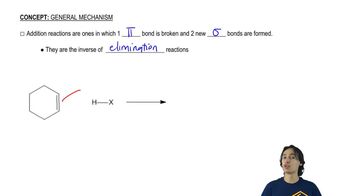
Features of Addition Mechanisms.

Oxidation Mechanisms

Oxidation mechanisms in organic chemistry often involve the addition of oxygen or the removal of hydrogen. In the case of mCPBA, it acts as a peracid that can introduce an oxygen atom into the alkene, forming an epoxide. Recognizing how oxidation alters the structure and reactivity of the starting material is essential for proposing a detailed reaction mechanism.
Recommended video:
Guided course
01:31
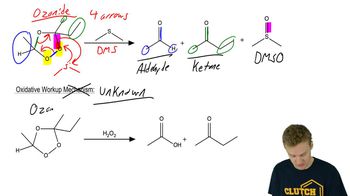
Oxidative Workup Mechanism:

Basic vs. Acidic Conditions

The reaction conditions, whether acidic or basic, significantly influence the mechanism and outcome of the reaction. Acidic conditions can stabilize carbocation intermediates, while basic conditions may favor nucleophilic attack on the epoxide formed. Understanding how these conditions affect electron density and the stability of intermediates is vital for accurately suggesting a reaction mechanism.
Recommended video:
Guided course
06:21
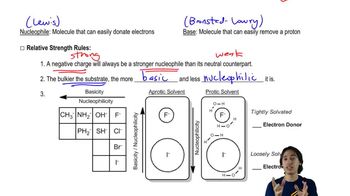
Understanding the difference between basicity and nucleophilicity.