Ch. 21 - Conjugated Systems I: Stability and Addition Reactions
Mullins - Organic Chemistry: A Learner Centered Approach 1st Edition
Mullins1st EditionOrganic Chemistry: A Learner Centered ApproachISBN: 9780137566471Not the one you use?Change textbook
Chapter 20, Problem 29

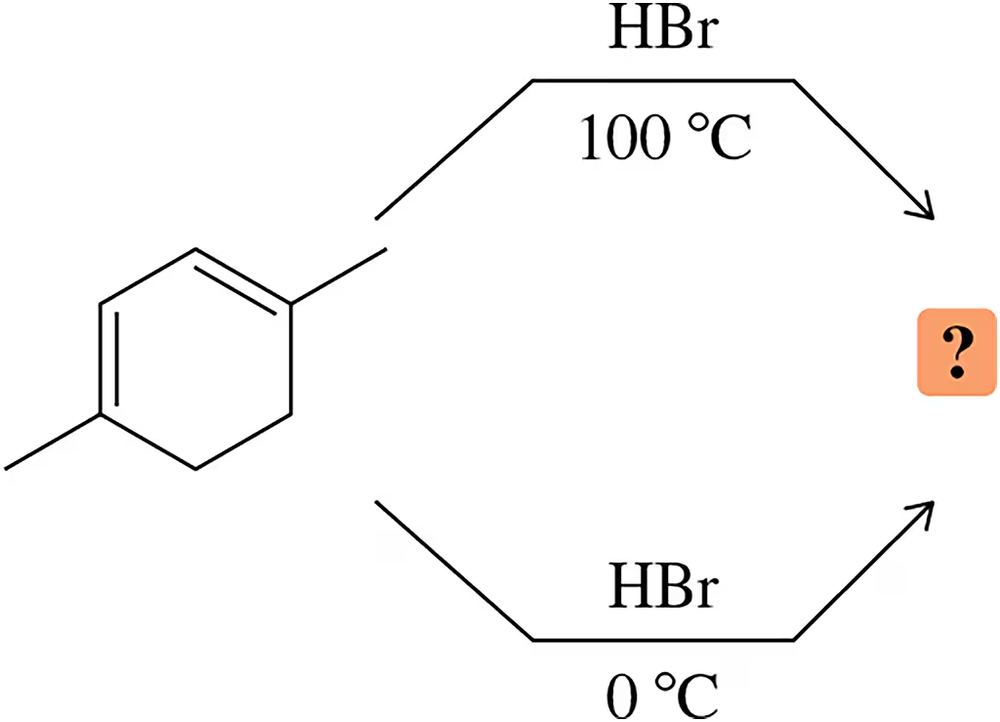
The following diene gives the same product regardless of whether the reaction is run under conditions of kinetic (0 °C) or thermodynamic (100 °C) control. Predict the product and explain this observation.
Chemical reaction diagram showing a diene reacting with HBr at 0°C and 100°C, leading to the same product.

Verified step by step guidance
1
Identify the structure of the diene. A diene is a hydrocarbon with two double bonds. Determine the position and configuration of these double bonds in the given diene.
Consider the possible reaction pathways. Under kinetic control, reactions favor the formation of the product that forms fastest, often the one with the most stable transition state. Under thermodynamic control, reactions favor the formation of the most stable product.
Analyze the stability of potential products. Look at the possible products formed from the diene and assess their stability. Consider factors such as conjugation, steric hindrance, and hyperconjugation.
Determine why the same product is formed under both conditions. If the diene forms a product that is both kinetically and thermodynamically favored, it will be the major product under both conditions. This can occur if the transition state leading to the most stable product is also the most stable.
Predict the product. Based on the analysis, predict the structure of the product formed from the diene. Consider the stability and formation rate of the product to explain why it is favored under both kinetic and thermodynamic conditions.

Verified video answer for a similar problem:

This video solution was recommended by our tutors as helpful for the problem above.
Video duration:
2m
Was this helpful?

Key Concepts

Here are the essential concepts you must grasp in order to answer the question correctly.

Kinetic vs. Thermodynamic Control

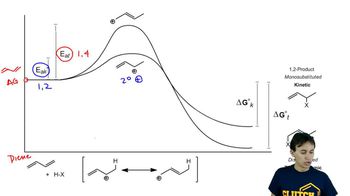
Kinetic control refers to conditions where the reaction pathway with the lowest activation energy predominates, often at lower temperatures, leading to the formation of the fastest-formed product. Thermodynamic control, on the other hand, occurs at higher temperatures where the most stable product is favored, as the system has enough energy to overcome higher activation barriers and reach the most stable state.
Recommended video:
Guided course
08:51
Kinetic vs. Thermodynamic Control

Diene Reactivity

Dienes are compounds with two double bonds, and their reactivity is influenced by the arrangement of these bonds. In reactions like the Diels-Alder reaction, the conformation and substitution pattern of the diene can determine the regioselectivity and stereoselectivity of the product. Understanding the electronic and steric factors that affect diene reactivity is crucial for predicting reaction outcomes.
Recommended video:
Guided course
04:43
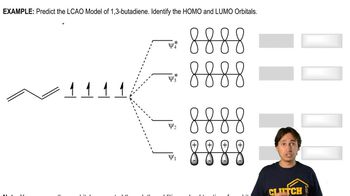
Drawing MO Diagram for Dienes

Reaction Mechanism and Product Stability

The mechanism of a reaction dictates the pathway and intermediates formed, which in turn influence the final product. In this context, the same product under both kinetic and thermodynamic conditions suggests that the product is both the fastest-formed and the most stable. This can occur if the reaction mechanism leads to a single, highly stable product, regardless of the conditions.
Recommended video:
Guided course
03:43
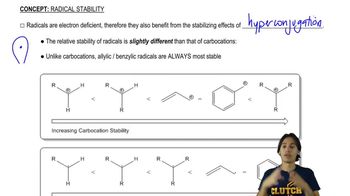
The radical stability trend.