Ch. 21 - Conjugated Systems I: Stability and Addition Reactions
Mullins - Organic Chemistry: A Learner Centered Approach 1st Edition
Mullins1st EditionOrganic Chemistry: A Learner Centered ApproachISBN: 9780137566471Not the one you use?Change textbook
Chapter 20, Problem 18

Which of the following would you expect to be a more stable molecular orbital? Why?
<IMAGE>

Verified step by step guidance
1
Step 1: Analyze the molecular orbital diagrams provided in the image. Diagram (I) shows a bonding molecular orbital where the lobes of the atomic orbitals overlap constructively (same phase, indicated by matching signs). Diagram (II) shows an antibonding molecular orbital where the lobes of the atomic orbitals overlap destructively (opposite phases, indicated by opposite signs).
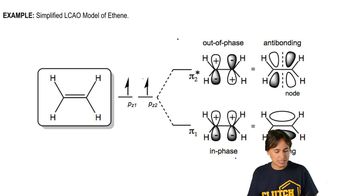
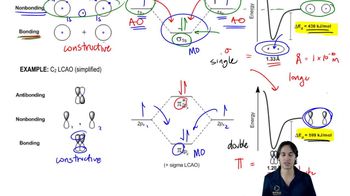
Step 2: Recall the concept of molecular orbital stability. Bonding molecular orbitals are more stable because constructive overlap leads to increased electron density between the nuclei, which stabilizes the molecule. Antibonding molecular orbitals are less stable because destructive overlap reduces electron density between the nuclei, leading to repulsion.
Step 3: Examine the phase alignment in Diagram (I). The constructive overlap of orbitals in the bonding molecular orbital results in a lower energy state, making it more stable.
Step 4: Examine the phase alignment in Diagram (II). The destructive overlap of orbitals in the antibonding molecular orbital results in a higher energy state, making it less stable.
Step 5: Conclude that the bonding molecular orbital (Diagram I) is more stable than the antibonding molecular orbital (Diagram II) due to the constructive overlap of atomic orbitals, which increases electron density between the nuclei and lowers the energy of the system.

Verified video answer for a similar problem:

This video solution was recommended by our tutors as helpful for the problem above.
Video duration:
6m
Was this helpful?

Key Concepts

Here are the essential concepts you must grasp in order to answer the question correctly.

Molecular Orbital Theory

Molecular Orbital Theory describes how atomic orbitals combine to form molecular orbitals, which can be occupied by electrons. These molecular orbitals can be bonding, antibonding, or non-bonding, influencing the stability of the molecule. The stability of a molecular orbital is determined by the energy levels and the overlap of the atomic orbitals involved in its formation.
Recommended video:
Guided course
08:41
Review of Molecular Orbitals

Bonding vs. Antibonding Orbitals

Bonding orbitals are formed when atomic orbitals combine constructively, resulting in a lower energy state and increased stability for the molecule. In contrast, antibonding orbitals arise from destructive interference, leading to a higher energy state and decreased stability. The presence of electrons in bonding orbitals contributes to molecular stability, while electrons in antibonding orbitals can destabilize the molecule.
Recommended video:
Guided course
03:25
Sigma bond vs. pi bond, which is stronger?

Electron Configuration in Molecular Orbitals

The electron configuration in molecular orbitals follows the Aufbau principle, where electrons fill the lowest energy orbitals first. The stability of a molecular orbital can be assessed by counting the number of electrons in bonding versus antibonding orbitals. A greater number of electrons in bonding orbitals compared to antibonding orbitals indicates a more stable molecular configuration.
Recommended video:
Guided course
04:12
The Electron Configuration