Ch. 21 - Conjugated Systems I: Stability and Addition Reactions
Mullins - Organic Chemistry: A Learner Centered Approach 1st Edition
Mullins1st EditionOrganic Chemistry: A Learner Centered ApproachISBN: 9780137566471Not the one you use?Change textbook
Chapter 20, Problem 36g,h,i

Would you expect the following nucleophiles to do 1,2- or 1,4-addition?
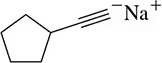
(g) Cyclopentyl acetylide anion with sodium counterion, showing a five-membered ring attached to a triple-bonded carbon.
(h) Chemical structure of a Grignard reagent with a conjugated diene and a magnesium bromide group.
(i) Chemical structure of lithium diisopropylcuprate, showing two isopropyl groups bonded to copper with lithium ion.

Verified step by step guidance
1
Identify the type of nucleophile: Determine whether the nucleophile is a strong or weak nucleophile. Strong nucleophiles tend to favor 1,2-addition, while weak nucleophiles often favor 1,4-addition.
Analyze the electrophile: Consider the structure of the electrophile, particularly if it is an α,β-unsaturated carbonyl compound. This will help determine the possible sites for nucleophilic attack.
Consider the reaction conditions: The conditions under which the reaction is carried out (e.g., temperature, solvent) can influence whether 1,2- or 1,4-addition is favored.
Evaluate the stability of intermediates: 1,4-addition often leads to more stable intermediates, such as enolates or enols, which can be a deciding factor in the reaction pathway.
Predict the outcome: Based on the analysis of the nucleophile, electrophile, and reaction conditions, predict whether 1,2- or 1,4-addition is more likely to occur for each nucleophile.

Verified video answer for a similar problem:

This video solution was recommended by our tutors as helpful for the problem above.
Video duration:
3m
Was this helpful?

Key Concepts

Here are the essential concepts you must grasp in order to answer the question correctly.

Nucleophiles

Nucleophiles are species that donate an electron pair to form a chemical bond in reaction mechanisms. They are typically negatively charged or neutral molecules with lone pairs of electrons. Understanding the nature of nucleophiles, such as their charge, size, and electron density, is crucial for predicting their behavior in addition reactions.
Recommended video:
Guided course
08:27
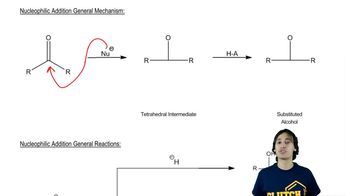
Nucleophilic Addition

1,2-Addition

1,2-Addition, also known as direct addition, occurs when a nucleophile adds to the carbon atom directly adjacent to the carbonyl group in an α,β-unsaturated carbonyl compound. This type of addition is favored by strong, small nucleophiles and results in the formation of a new bond at the carbonyl carbon, often leading to a more stable product in kinetic terms.
Recommended video:
Guided course
09:23
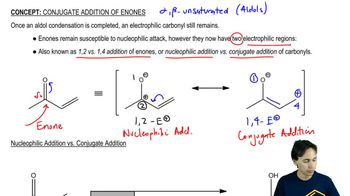
1,2 vs 1,4 Addition

1,4-Addition

1,4-Addition, or conjugate addition, involves the nucleophile adding to the β-carbon of an α,β-unsaturated carbonyl compound. This pathway is typically favored by weaker, larger nucleophiles and results in the formation of a more stable product in thermodynamic terms. Understanding the conditions and nucleophile characteristics that favor 1,4-addition is essential for predicting reaction outcomes.
Recommended video:
Guided course
09:23
1,2 vs 1,4 Addition