Ch. 22 - Conjugated Systems II: Pericyclic Reactions
Mullins - Organic Chemistry: A Learner Centered Approach 1st Edition
Mullins1st EditionOrganic Chemistry: A Learner Centered ApproachISBN: 9780137566471Not the one you use?Change textbook
Chapter 21, Problem 15c

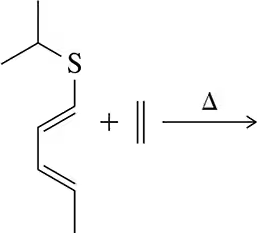
Assuming the diene approaches the dienophile from the top, predict the product of the following Diels–Alder reactions.
(c) Chemical reaction diagram showing a diene with a sulfur atom reacting with a dienophile under heat.

Verified step by step guidance
1
Identify the diene and dienophile in the reaction. The diene is a conjugated system with two double bonds, and the dienophile is typically an alkene or alkyne that will react with the diene.
Consider the stereochemistry of the reaction. The Diels–Alder reaction is a [4+2] cycloaddition, meaning four π electrons from the diene and two π electrons from the dienophile participate in forming a six-membered ring.
Visualize the approach of the diene to the dienophile from the top. This orientation can affect the stereochemistry of the product, often leading to endo or exo products. The endo product is typically favored due to secondary orbital interactions.
Draw the transition state where the diene and dienophile are aligned to form new σ bonds. The new bonds will form between the ends of the diene and the ends of the dienophile, resulting in a cyclohexene ring.
Predict the stereochemistry of the product based on the approach. If the diene approaches from the top, substituents on the dienophile may end up on the same side of the newly formed ring, influencing the final stereochemistry of the product.

Verified video answer for a similar problem:

This video solution was recommended by our tutors as helpful for the problem above.
Was this helpful?

Key Concepts

Here are the essential concepts you must grasp in order to answer the question correctly.

Diels–Alder Reaction

The Diels–Alder reaction is a [4+2] cycloaddition reaction between a conjugated diene and a dienophile, typically an alkene or alkyne, to form a six-membered ring. This reaction is stereospecific and occurs in a concerted manner, meaning all bond-making and bond-breaking processes happen simultaneously. It is a key reaction in organic synthesis for constructing complex cyclic structures.
Recommended video:
Guided course
04:02
Diels-Alder Retrosynthesis

Stereochemistry in Diels–Alder Reactions

Stereochemistry is crucial in Diels–Alder reactions as the relative orientation of substituents on the diene and dienophile affects the stereochemistry of the product. The reaction is stereospecific, preserving the stereochemistry of the reactants. The diene can approach the dienophile from either the top or bottom face, leading to different stereoisomers, which is important for predicting the product's configuration.
Recommended video:
Guided course
04:02
Diels-Alder Retrosynthesis

Endo and Exo Products

In Diels–Alder reactions, the terms 'endo' and 'exo' describe the relative positions of substituents in the product. The endo product is typically favored due to secondary orbital interactions, where substituents on the dienophile are oriented towards the diene's π-system. Understanding these interactions helps predict which product will be predominant under kinetic control, especially when the diene approaches from a specific direction.
Recommended video:
Guided course
11:07
Bridged-Products