
Ch. 22 - Conjugated Systems II: Pericyclic Reactions
Mullins - Organic Chemistry: A Learner Centered Approach 1st Edition
Mullins1st EditionOrganic Chemistry: A Learner Centered ApproachISBN: 9780137566471Not the one you use?Change textbook
Chapter 21, Problem 44c

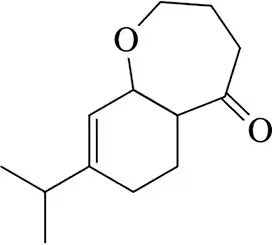
Suggest a diene and a dienophile that would give the following products.
(c) Chemical structure of a bicyclic compound with a six-membered ring and an oxygen-containing seven-membered ring.

Verified step by step guidance
1
Identify the product structure and determine the connectivity of the atoms. Look for any new sigma bonds formed and any pi bonds that have been broken.
Recognize that the product is likely the result of a Diels-Alder reaction, which involves a diene and a dienophile. The Diels-Alder reaction is a [4+2] cycloaddition reaction.
Examine the product to identify the six-membered ring, which is characteristic of a Diels-Alder reaction. Determine which part of the product corresponds to the diene and which part corresponds to the dienophile.
Consider the stereochemistry of the product. The Diels-Alder reaction is stereospecific, meaning that the stereochemistry of the diene and dienophile will influence the stereochemistry of the product.
Propose a diene and a dienophile that, when reacted together, would form the observed product. Ensure that the diene has conjugated double bonds and the dienophile has an electron-withdrawing group to facilitate the reaction.

Verified video answer for a similar problem:

This video solution was recommended by our tutors as helpful for the problem above.
Was this helpful?

Key Concepts

Here are the essential concepts you must grasp in order to answer the question correctly.

Diels-Alder Reaction

The Diels-Alder reaction is a [4+2] cycloaddition reaction between a conjugated diene and a dienophile, typically an alkene or alkyne, to form a six-membered ring. This reaction is stereospecific and can create complex cyclic structures in a single step, making it a powerful tool in synthetic organic chemistry.
Recommended video:
Guided course
04:02
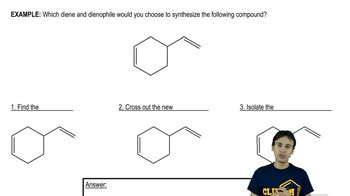
Diels-Alder Retrosynthesis

Conjugated Diene

A conjugated diene consists of two double bonds separated by a single bond, allowing for electron delocalization across the pi system. This delocalization stabilizes the diene and makes it more reactive in cycloaddition reactions like the Diels-Alder reaction. Common examples include 1,3-butadiene and isoprene.
Recommended video:
Guided course
03:27
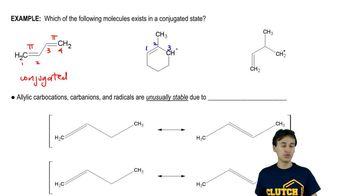
Conjugated states

Dienophile

A dienophile is an electron-deficient alkene or alkyne that reacts with a diene in the Diels-Alder reaction. The presence of electron-withdrawing groups, such as carbonyls or nitriles, enhances the dienophile's reactivity by increasing its electrophilicity, facilitating the cycloaddition process.
Recommended video:
Guided course
09:48
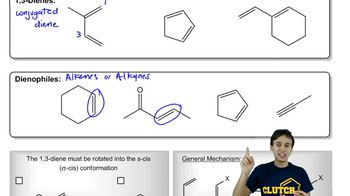
General Features
Related Practice
Textbook Question

The [2 + 2] cyclization is especially useful when done intramolecularly. 

(a) What makes intramolecular reactions more favorable? 

(b) Predict the product of the following cyclization (slight modification of a reaction from Angew. Chem. 2011, 50, 5149)

1055
views
Textbook Question

Predict the product of the following reactions. [When all of the reactions from this chapter are shown together, you must first decide which type of reaction each is. Is it a Diels–Alder, an electrocyclic, or a sigmatropic rearrangement? Drawing the product will be easier once this determination is made.]

(b)

617
views
Textbook Question

The Claisen rearrangement can be used to attach allyl groups to benzene via initial alkylation of a phenol.

(a) Predict the identity of A and B

(b) provide an arrow-pushing mechanism for each step. [The phenol alkylation is simply a Williamson ether synthesis reaction.]


631
views
Textbook Question

Predict the product of the following reactions. [When all of the reactions from this chapter are shown together, you must first decide which type of reaction each is. Is it a Diels–Alder, an electrocyclic, or a sigmatropic rearrangement? Drawing the product will be easier once this determination is made.]

(a)

838
views
Textbook Question

Predict the product of the Claisen reactions shown.

(c)

1236
views
Textbook Question

By forming a Lewis acid–Lewis base complex with the dienophile, Lewis acids are able to increase the rate of Diels–Alder reactions. Why might this be true?

560
views