Ch. 22 - Conjugated Systems II: Pericyclic Reactions
Mullins - Organic Chemistry: A Learner Centered Approach 1st Edition
Mullins1st EditionOrganic Chemistry: A Learner Centered ApproachISBN: 9780137566471Not the one you use?Change textbook
Chapter 21, Problem 4

What frequency of light would be required to excite an electron if the HOMO–LUMO energy gap was 33.9 kcal/mol (142 kJ/mol)?

Verified step by step guidance
1
Step 1: Understand the relationship between energy and frequency. The energy of a photon is related to its frequency by the equation E = hν, where E is the energy, h is Planck's constant (6.626 × 10⁻³⁴ J·s), and ν is the frequency of the light.
Step 2: Convert the given energy from kcal/mol or kJ/mol to joules per molecule. Use the conversion factors: 1 kcal = 4184 J and 1 mol = 6.022 × 10²³ molecules. For example, 33.9 kcal/mol can be converted to joules per molecule by dividing the total energy in joules by Avogadro's number.
Step 3: Rearrange the equation E = hν to solve for frequency (ν). The formula becomes ν = E/h, where E is the energy in joules per molecule and h is Planck's constant.
Step 4: Substitute the calculated energy value (in joules per molecule) and Planck's constant into the equation ν = E/h to determine the frequency of light required to excite the electron.
Step 5: Ensure the frequency is expressed in appropriate units, such as hertz (Hz), which is equivalent to s⁻¹. If needed, convert the frequency to other units like THz (terahertz) for better interpretation.

Verified video answer for a similar problem:

This video solution was recommended by our tutors as helpful for the problem above.
Video duration:
7m
Was this helpful?

Key Concepts

Here are the essential concepts you must grasp in order to answer the question correctly.

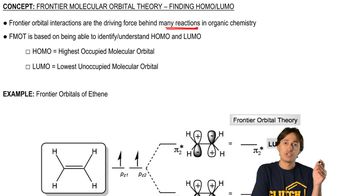
HOMO-LUMO Gap

The HOMO-LUMO gap refers to the energy difference between the highest occupied molecular orbital (HOMO) and the lowest unoccupied molecular orbital (LUMO) in a molecule. This gap is crucial in determining the electronic properties of a compound, including its reactivity and color. A smaller gap typically indicates that a molecule can absorb lower energy light, while a larger gap requires higher energy light for electronic transitions.
Recommended video:
Guided course
02:35
HOMO vs. LUMO

Energy and Frequency Relationship

The energy of a photon is directly related to its frequency through the equation E = hν, where E is energy, h is Planck's constant, and ν (nu) is the frequency. This relationship implies that higher energy photons correspond to higher frequencies. Understanding this relationship is essential for calculating the frequency of light needed to excite an electron across the HOMO-LUMO gap.
Recommended video:
Guided course
06:07
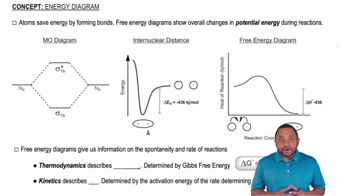
Introduction to free energy diagrams.

Conversion of Energy Units

In organic chemistry, energy is often expressed in different units, such as kcal/mol or kJ/mol. To calculate the frequency of light required for an electronic transition, it is necessary to convert these energy units into joules (J). This conversion is essential for applying the energy-frequency relationship accurately, as the standard unit for energy in the equation E = hν is joules.
Recommended video:
Guided course
02:18
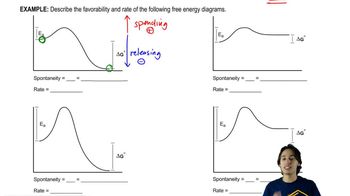
Favorability and rate of Free Energy Diagrams