
Ch. 23 - Benzene I: Aromatic Stability and Substitution Reactions
Mullins - Organic Chemistry: A Learner Centered Approach 1st Edition
Mullins1st EditionOrganic Chemistry: A Learner Centered ApproachISBN: 9780137566471Not the one you use?Change textbook
Chapter 22, Problem 77

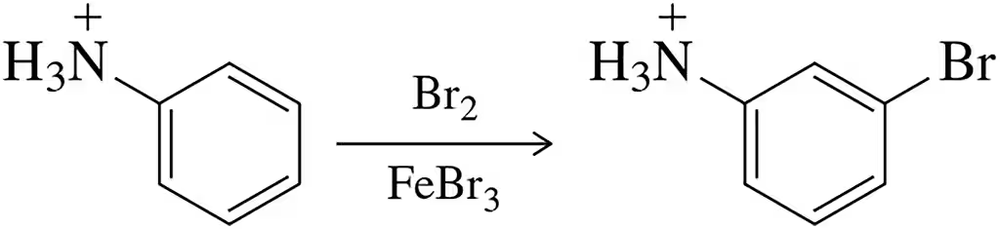
Protonation of aniline slows electrophilic aromatic substitution and directs electrophiles to the meta position. Why?
Chemical reaction diagram showing protonated aniline reacting with bromine, resulting in meta-substituted brominated product.

Verified step by step guidance
1
Understand the structure of aniline: Aniline is a benzene ring with an amino group (NH2) attached. The amino group is an electron-donating group, which typically activates the benzene ring towards electrophilic aromatic substitution (EAS) and directs electrophiles to the ortho and para positions.
Consider the effect of protonation: When aniline is protonated, the amino group becomes NH3+, which is a positively charged species. This changes the electronic nature of the group from electron-donating to electron-withdrawing.
Analyze the impact on reactivity: The protonated amino group (NH3+) withdraws electron density from the benzene ring, making it less reactive towards electrophiles. This is because the positive charge on the nitrogen reduces the electron density available for the aromatic ring to participate in EAS.
Determine the directing effect: The electron-withdrawing nature of the NH3+ group destabilizes the ortho and para positions due to the positive charge, making them less favorable for substitution. As a result, electrophiles are directed to the meta position, which is less destabilized by the electron-withdrawing effect.
Conclude the overall effect: Protonation of aniline decreases the reactivity of the benzene ring towards EAS and changes the directing effect from ortho/para to meta, due to the electron-withdrawing nature of the NH3+ group.

Verified video answer for a similar problem:

This video solution was recommended by our tutors as helpful for the problem above.
Was this helpful?

Key Concepts

Here are the essential concepts you must grasp in order to answer the question correctly.

Protonation of Aniline

Protonation of aniline involves the addition of a proton (H+) to the nitrogen atom of the aniline molecule, forming an anilinium ion. This process significantly reduces the electron density on the benzene ring because the lone pair on nitrogen, which would otherwise donate electrons to the ring, is now involved in bonding with the proton. This electron withdrawal makes the ring less reactive towards electrophilic aromatic substitution.
Recommended video:
Guided course
05:15
Protection of Aniline Derivatives

Electrophilic Aromatic Substitution (EAS)

Electrophilic aromatic substitution is a reaction where an electrophile replaces a hydrogen atom on an aromatic ring. The reactivity and position of substitution depend on the substituents already present on the ring. Electron-donating groups activate the ring and direct substitution to ortho and para positions, while electron-withdrawing groups deactivate the ring and direct substitution to the meta position.
Recommended video:

Meta-Directing Effect

The meta-directing effect occurs when a substituent on an aromatic ring withdraws electron density, making the ortho and para positions less favorable for electrophilic attack. In the case of protonated aniline, the positive charge on the nitrogen withdraws electrons from the ring, stabilizing the meta position for substitution. This effect is due to the reduced electron density at the ortho and para positions, making them less reactive towards electrophiles.
Recommended video:
2:02
Directing Effects in Substituted Pyrroles, Furans, and Thiophenes Concept 1