Ch. 23 - Benzene I: Aromatic Stability and Substitution Reactions
Mullins - Organic Chemistry: A Learner Centered Approach 1st Edition
Mullins1st EditionOrganic Chemistry: A Learner Centered ApproachISBN: 9780137566471Not the one you use?Change textbook
Chapter 22, Problem 5b

Suggest an arrow-pushing mechanism that accounts for the formation of the following Lewis acid–Lewis base complexes. Label the Lewis acid and Lewis base in each.
(b) Lewis acid-base reaction diagram showing arrow-pushing mechanism with labeled acid and base.

Verified step by step guidance
1
Step 1: Identify the Lewis acid and Lewis base in the reaction. The Lewis acid is Br⁺ because it is electron-deficient and can accept a pair of electrons. The Lewis base is the alkene because it has a π-electron cloud that can donate electrons.
Step 2: Begin the arrow-pushing mechanism by showing the π-electrons of the alkene attacking the Br⁺. Draw a curved arrow from the π-bond of the alkene to the Br⁺, indicating the donation of electrons.
Step 3: As the alkene donates electrons to Br⁺, a new bond forms between one of the carbon atoms in the alkene and the Br atom. This results in the formation of a carbocation intermediate on the other carbon atom of the alkene.
Step 4: Represent the carbocation intermediate explicitly, showing the positive charge on the carbon atom that did not bond with Br. This step is crucial for understanding the stability of the intermediate.
Step 5: Conclude the mechanism by showing the final Lewis acid–Lewis base complex, where the Br atom is bonded to one of the carbon atoms, and the other carbon atom carries a positive charge. Ensure the structure reflects the correct connectivity and charge distribution.

Verified video answer for a similar problem:

This video solution was recommended by our tutors as helpful for the problem above.
Was this helpful?

Key Concepts

Here are the essential concepts you must grasp in order to answer the question correctly.

Lewis Acids and Bases

Lewis acids are species that can accept an electron pair, while Lewis bases are species that can donate an electron pair. In the provided reaction, the bromonium ion (Br+) acts as a Lewis acid, accepting electron density from the alkene, which serves as the Lewis base. Understanding these definitions is crucial for analyzing acid-base reactions in organic chemistry.
Recommended video:
Guided course
02:49
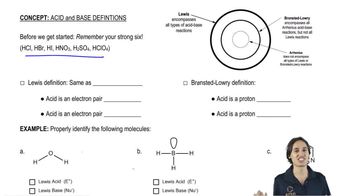
The Lewis definition of acids and bases.

Arrow-Pushing Mechanism

The arrow-pushing mechanism is a method used to illustrate the movement of electrons during chemical reactions. Arrows indicate the direction of electron flow, showing how bonds are formed or broken. In the given reaction, arrows would depict the donation of an electron pair from the alkene to the Br+ ion, leading to the formation of a new bond.
Recommended video:
Guided course
04:32
General Mechanism

Formation of Carbocations

Carbocations are positively charged carbon species that can form during reactions involving Lewis acids. In the context of the provided reaction, the interaction between the alkene and Br+ can lead to the formation of a carbocation intermediate. Understanding carbocation stability and reactivity is essential for predicting the outcome of many organic reactions.
Recommended video:
Guided course
07:21
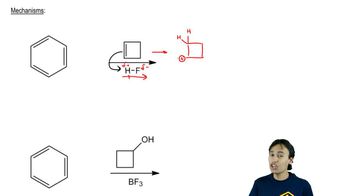
Any Carbocation