Ch. 24 - Benzene II: Reactions Influenced by the Aromatic Ring
Mullins - Organic Chemistry: A Learner Centered Approach 1st Edition
Mullins1st EditionOrganic Chemistry: A Learner Centered ApproachISBN: 9780137566471Not the one you use?Change textbook
Chapter 23, Problem 24a

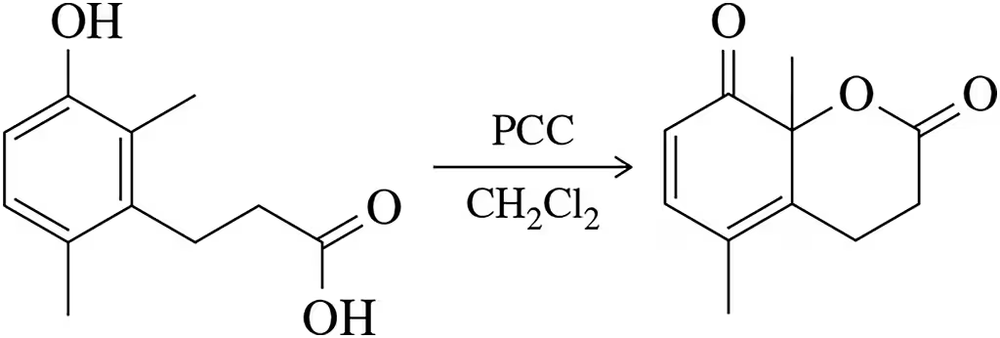
Oxidation of a phenol derivative produces the lactone shown. Provide an arrow-pushing mechanism that rationalizes this outcome.

Verified step by step guidance
1
Identify the phenol derivative structure and the lactone product. Recognize that the phenol derivative has an aromatic ring with a hydroxyl group attached, and the lactone is a cyclic ester.
Consider the oxidation process. Typically, phenol derivatives undergo oxidation to form quinones, which are key intermediates in forming lactones. The oxidizing agent will likely facilitate the conversion of the hydroxyl group to a carbonyl group.
Draw the initial step of the mechanism: the phenol derivative undergoes oxidation. Use arrow-pushing to show the movement of electrons from the hydroxyl group to form a carbonyl group, resulting in a quinone intermediate.
Next, illustrate the formation of the lactone. The quinone intermediate undergoes intramolecular nucleophilic attack, where an adjacent hydroxyl or alkoxy group attacks the carbonyl carbon, forming a cyclic structure. Use arrow-pushing to show this nucleophilic attack and the formation of the lactone ring.
Finally, ensure the mechanism accounts for any rearrangements or additional steps needed to stabilize the lactone product. This may involve proton transfers or tautomerization. Use arrow-pushing to show these final adjustments, resulting in the stable lactone structure.

Verified video answer for a similar problem:

This video solution was recommended by our tutors as helpful for the problem above.
Video duration:
9m
Was this helpful?

Key Concepts

Here are the essential concepts you must grasp in order to answer the question correctly.

Phenol Oxidation

Phenol oxidation involves the conversion of phenolic compounds into more oxidized forms, often through the formation of quinones or other oxygen-containing functional groups. This process typically requires an oxidizing agent, such as chromic acid or hydrogen peroxide, which facilitates the removal of hydrogen atoms and the addition of oxygen.
Recommended video:
1:47
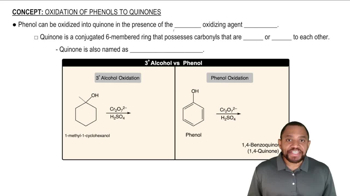
Oxidation of Phenols to Quinones Concept 1

Arrow-Pushing Mechanism

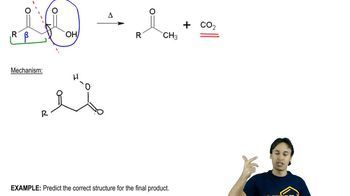
Arrow-pushing is a technique used in organic chemistry to illustrate the movement of electrons during chemical reactions. It involves drawing arrows to show how electron pairs move from nucleophiles to electrophiles, helping to visualize the step-by-step transformation of reactants into products. Understanding this concept is crucial for rationalizing reaction mechanisms.
Recommended video:
Guided course
04:32
General Mechanism

Lactone Formation

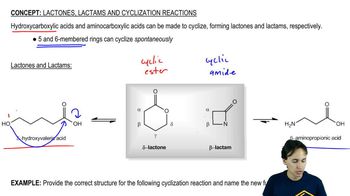
Lactones are cyclic esters formed through the intramolecular esterification of hydroxy acids. In the context of phenol oxidation, lactone formation can occur when an oxidized phenol derivative undergoes a ring closure, typically involving the nucleophilic attack of an alcohol group on a carbonyl carbon, resulting in the release of water and the formation of the lactone ring.
Recommended video:
Guided course
05:19
Lactones and Lactams