Ch. 25 - Amines: Structure, Reactions, and Synthesis
Mullins - Organic Chemistry: A Learner Centered Approach 1st Edition
Mullins1st EditionOrganic Chemistry: A Learner Centered ApproachISBN: 9780137566471Not the one you use?Change textbook
Chapter 24, Problem 67

The final step in the synthesis of diazoxide, a drug used to treat low blood pressure, is shown here. Suggest a mechanism for this step.
Chemical reaction diagram illustrating the final step in diazoxide synthesis, featuring nitrogenous nucleophiles.

Verified step by step guidance
1
Identify the reactants and products: The reactants are a sulfonamide with a chlorine substituent on the benzene ring and acetic anhydride. The product is diazoxide, which has a cyclic structure with a sulfonamide group and a nitrogen-containing ring.
Recognize the functional groups involved: The sulfonamide group (SO2NH2) and the acetic anhydride (CH3CO) are key functional groups. The acetic anhydride is likely to act as an acylating agent.
Consider the nucleophilic attack: The nitrogen atom in the sulfonamide group can act as a nucleophile, attacking the electrophilic carbonyl carbon of the acetic anhydride. This forms a tetrahedral intermediate.
Formation of the cyclic structure: After the nucleophilic attack, the intermediate can undergo intramolecular cyclization. The nitrogen atom can attack the carbonyl carbon of the acetic anhydride, leading to the formation of the cyclic structure present in diazoxide.
Loss of acetic acid: The cyclization step results in the expulsion of acetic acid, completing the formation of the diazoxide structure. This step involves the reformation of the carbonyl group and stabilization of the cyclic product.

Verified video answer for a similar problem:

This video solution was recommended by our tutors as helpful for the problem above.
Video duration:
9m
Was this helpful?

Key Concepts

Here are the essential concepts you must grasp in order to answer the question correctly.

Reaction Mechanisms

A reaction mechanism is a step-by-step description of how a chemical reaction occurs at the molecular level. It outlines the sequence of elementary steps, including bond breaking and formation, and the intermediates formed during the reaction. Understanding mechanisms is crucial for predicting the products and the conditions under which a reaction occurs.
Recommended video:
Guided course
02:16
Heck Reaction Mechanism

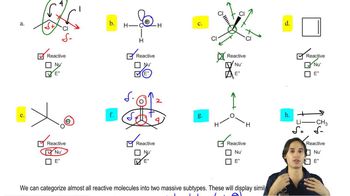
Nucleophiles and Electrophiles

Nucleophiles are species that donate an electron pair to form a chemical bond, while electrophiles are electron-deficient species that accept an electron pair. In organic reactions, the interaction between nucleophiles and electrophiles is fundamental, as it drives the formation of new bonds and the transformation of reactants into products.
Recommended video:
Guided course
03:
Nucleophile or Electrophile

Functional Groups

Functional groups are specific groups of atoms within molecules that are responsible for the characteristic chemical reactions of those molecules. Identifying functional groups in a compound is essential for predicting its reactivity and the types of reactions it can undergo, which is particularly important in the synthesis of complex organic compounds like diazoxide.
Recommended video:
Guided course
02:36
Identifying Functional Groups