Ch. 27 - Carbohydrates, Nucleic Acids, and Lipids
Mullins - Organic Chemistry: A Learner Centered Approach 1st Edition
Mullins1st EditionOrganic Chemistry: A Learner Centered ApproachISBN: 9780137566471Not the one you use?Change textbook
Chapter 26, Problem 5b

In each pair, which would you expect to have the higher melting point?
(b) Two molecular structures are shown side by side, with a label indicating a comparison of their melting points.

Verified step by step guidance
1
Identify the two compounds in the pair and write their chemical structures. Analyze their molecular features such as polarity, molecular weight, and functional groups.
Consider the type of intermolecular forces present in each compound. For example, hydrogen bonding, dipole-dipole interactions, and London dispersion forces. Stronger intermolecular forces generally lead to higher melting points.
Evaluate the molecular symmetry of each compound. More symmetrical molecules tend to pack more efficiently in a crystal lattice, which can increase the melting point.
Compare the molecular weights of the two compounds. Higher molecular weight can contribute to stronger London dispersion forces, which may increase the melting point.
Summarize the findings by determining which compound has stronger intermolecular forces, better packing efficiency, or higher molecular weight, and conclude which one is expected to have the higher melting point.

Verified video answer for a similar problem:

This video solution was recommended by our tutors as helpful for the problem above.
Video duration:
2m
Was this helpful?

Key Concepts

Here are the essential concepts you must grasp in order to answer the question correctly.

Intermolecular Forces

Intermolecular forces are the attractive forces between molecules that influence physical properties like melting and boiling points. Stronger intermolecular forces, such as hydrogen bonding or ionic interactions, typically result in higher melting points. Understanding the types of intermolecular forces present in the compounds being compared is crucial for predicting their melting points.
Recommended video:
Guided course
03:01
How Van der Waals forces work.

Molecular Structure

The molecular structure, including the arrangement of atoms and the presence of functional groups, significantly affects a compound's melting point. For example, symmetrical molecules may pack more efficiently in a solid state, leading to higher melting points. Analyzing the structural features of the compounds in question helps in determining which one is likely to have a higher melting point.
Recommended video:
Guided course
08:41
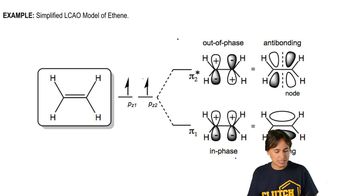
Review of Molecular Orbitals

Polarity

Polarity refers to the distribution of electrical charge over the atoms in a molecule. Polar molecules tend to have stronger dipole-dipole interactions compared to nonpolar molecules, which primarily experience weaker London dispersion forces. The polarity of the compounds being compared can provide insight into their melting points, as polar compounds generally exhibit higher melting points due to stronger intermolecular attractions.
Recommended video:
Guided course
2:04
Molecular Polarity