Ch. 3 - Alkanes and Cycloalkanes: Properties and Conformational Analysis
Mullins - Organic Chemistry: A Learner Centered Approach 1st Edition
Mullins1st EditionOrganic Chemistry: A Learner Centered ApproachISBN: 9780137566471Not the one you use?Change textbook
Chapter 2, Problem 29a

Choose the conformation in each pair that is most stable. If both are equally stable, then write 'no difference.'
(a)

Verified step by step guidance
1
Analyze the two cyclohexane chair conformations provided in the image. Note the positions of the substituents, particularly the methyl group (CH₃) and hydrogen atoms (H). Determine whether the substituents are in axial or equatorial positions.
Recall that substituents in the equatorial position experience less steric hindrance compared to those in the axial position due to reduced 1,3-diaxial interactions. This makes equatorial positions more stable for bulky groups like CH₃.
In the first conformation (left), the methyl group (CH₃) is in the equatorial position, while in the second conformation (right), the methyl group is in the axial position.
Compare the steric hindrance in both conformations. The first conformation (left) is more stable because the bulky methyl group is in the equatorial position, minimizing steric interactions.
Conclude that the most stable conformation is the one where the methyl group is in the equatorial position (left conformation).

Verified video answer for a similar problem:

This video solution was recommended by our tutors as helpful for the problem above.
Was this helpful?

Key Concepts

Here are the essential concepts you must grasp in order to answer the question correctly.

Conformational Analysis

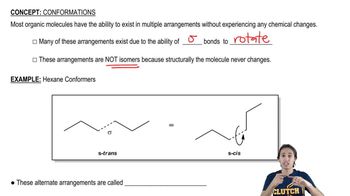
Conformational analysis involves studying the different spatial arrangements of atoms in a molecule that can be interconverted by rotation around single bonds. This analysis helps in understanding the stability of various conformations based on steric interactions, torsional strain, and angle strain. Identifying the most stable conformation is crucial for predicting the behavior and reactivity of organic compounds.
Recommended video:
Guided course
03:29
Understanding what a conformer is.

Steric Hindrance

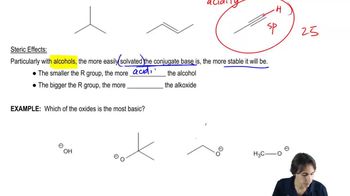
Steric hindrance refers to the repulsion between atoms that occurs when they are brought close together, which can destabilize certain conformations. In organic molecules, bulky groups can create steric strain, making some conformations less favorable than others. Understanding steric hindrance is essential for determining which conformation is more stable in a given pair.
Recommended video:
Guided course
02:53
Understanding steric effects.

Torsional Strain

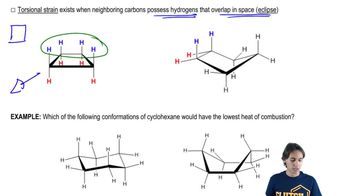
Torsional strain arises from the eclipsing interactions between atoms or groups in a molecule when they are aligned in a way that increases electron repulsion. This strain is particularly relevant in conformations where bonds are eclipsed rather than staggered. Recognizing torsional strain helps in evaluating the stability of different conformations and predicting which will be favored in a molecular structure.
Recommended video:
Guided course
02:00
What is torsional strain?