Ch. 3 - Alkanes and Cycloalkanes: Properties and Conformational Analysis
Mullins - Organic Chemistry: A Learner Centered Approach 1st Edition
Mullins1st EditionOrganic Chemistry: A Learner Centered ApproachISBN: 9780137566471Not the one you use?Change textbook
Chapter 2, Problem 11b

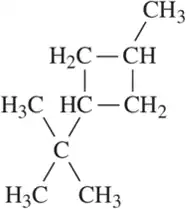
Convert the following hybrid structural formulas into the line-angle drawings.
(b) Hybrid structural formula of a hydrocarbon showing carbon and hydrogen atoms connected by single bonds.

Verified step by step guidance
1
Identify the hybrid structural formula provided. In a hybrid structural formula, atoms are represented explicitly, and bonds are shown as lines. Hydrogen atoms attached to carbons are often implied but may be shown explicitly.
Determine the backbone of the molecule, which is typically a chain or ring of carbon atoms. In a line-angle drawing, each vertex represents a carbon atom, and lines represent bonds between them.
Remove explicit hydrogen atoms bonded to carbons. In line-angle drawings, hydrogens attached to carbons are implied and not shown explicitly. However, hydrogens attached to heteroatoms (e.g., oxygen, nitrogen) are usually shown.
Convert any functional groups or substituents into their appropriate representations. For example, hydroxyl groups (-OH), carbonyl groups (C=O), and halogens (e.g., Cl, Br) should be drawn explicitly.
Draw the final line-angle structure, ensuring that the correct number of bonds is maintained for each carbon atom (four bonds total, including implied hydrogens). Double-check the structure for accuracy and consistency with the original hybrid formula.

Verified video answer for a similar problem:

This video solution was recommended by our tutors as helpful for the problem above.
Video duration:
3m
Was this helpful?

Key Concepts

Here are the essential concepts you must grasp in order to answer the question correctly.

Hybrid Structural Formulas

Hybrid structural formulas represent molecules by showing the connectivity of atoms and the arrangement of bonds. They combine elements of both Lewis structures and condensed formulas, providing a detailed view of how atoms are bonded in a molecule. Understanding these formulas is crucial for accurately translating them into line-angle drawings.
Recommended video:
Guided course
04:58
Bond sites, hybridization, and intermediate orbitals

Line-Angle Drawings

Line-angle drawings, also known as skeletal structures, are a simplified way to represent organic molecules. In these drawings, carbon atoms are represented by the ends and intersections of lines, while hydrogen atoms are typically omitted for clarity. This method allows chemists to visualize complex structures quickly and is essential for interpreting and communicating molecular geometry.
Recommended video:
Guided course
02:46
What is angle strain?

Bonding and Connectivity

Bonding and connectivity refer to how atoms are linked together in a molecule, including single, double, and triple bonds. Understanding these concepts is vital for converting hybrid structural formulas into line-angle drawings, as it ensures that the correct number of bonds and the overall shape of the molecule are accurately represented in the simplified format.
Recommended video:
3:15
Disulfide Bonds Example 2