
Ch. 3 - Alkanes and Cycloalkanes: Properties and Conformational Analysis
Mullins - Organic Chemistry: A Learner Centered Approach 1st Edition
Mullins1st EditionOrganic Chemistry: A Learner Centered ApproachISBN: 9780137566471Not the one you use?Change textbook
Chapter 2, Problem 54e

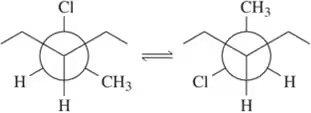
For each pair of conformations shown, choose which is most stable. [If both conformations have the same number of gauche interactions, choose the one where the interactions are between smaller groups.]
(e) Two Newman projections of a cycloalkane showing different conformations with chlorine and methyl groups.

Verified step by step guidance
1
Step 1: Understand the concept of conformational stability. Stability in conformations is influenced by steric hindrance and gauche interactions. Gauche interactions occur when two substituents are separated by a dihedral angle of approximately 60°, leading to increased steric strain.
Step 2: Analyze the conformations provided in the problem. Identify the substituents attached to the molecule and their relative positions in each conformation. Look for any gauche interactions between substituents.
Step 3: Count the number of gauche interactions in each conformation. If one conformation has fewer gauche interactions, it is more stable. Use the formula for dihedral angles to identify gauche interactions: 60°.
Step 4: If both conformations have the same number of gauche interactions, compare the size of the groups involved in the interactions. Smaller groups cause less steric strain, making the conformation with smaller interacting groups more stable.
Step 5: Choose the most stable conformation based on the analysis above. Ensure that you consider both the number of gauche interactions and the size of the groups involved in those interactions.

Verified video answer for a similar problem:

This video solution was recommended by our tutors as helpful for the problem above.
Video duration:
1m
Was this helpful?

Key Concepts

Here are the essential concepts you must grasp in order to answer the question correctly.

Conformational Analysis

Conformational analysis involves studying the different spatial arrangements of a molecule that can be interconverted by rotation around single bonds. These conformations can significantly influence the stability and reactivity of the molecule. Understanding the energy associated with each conformation helps predict which arrangement is more stable under given conditions.
Recommended video:
Guided course
03:29
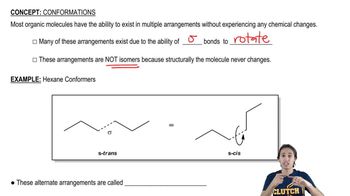
Understanding what a conformer is.

Gauche Interactions

Gauche interactions occur when two substituents on adjacent carbon atoms are positioned 60 degrees apart in a staggered conformation. These interactions can introduce steric strain, making certain conformations less stable. In evaluating stability, conformations with fewer or less significant gauche interactions are generally preferred, especially when comparing larger groups.
Recommended video:
2:41
Interactions within the Tertiary Structure Concept 2

Steric Hindrance

Steric hindrance refers to the repulsion between atoms that occurs when they are brought close together, often due to their size. In conformational analysis, larger substituents can create more steric hindrance, leading to increased energy and decreased stability of a conformation. Thus, when comparing conformations, those with smaller groups experiencing less steric hindrance are typically more stable.
Recommended video:
Guided course
02:53
Understanding steric effects.
Related Practice
Textbook Question

Given the following structures, show the Newman projection that would result from looking down the indicated bond in the direction shown. [Orient yourself as if you were the eyeball looking down the bond. Some of the examples have been partially completed for you to fill in the rest.]

(l) <IMAGE>

1431
views
Textbook Question

For each pair of conformations shown, choose which is most stable. [If both conformations have the same number of gauche interactions, choose the one where the interactions are between smaller groups.]

(f)

1179
views
Textbook Question

Given the following structures, show the Newman projection that would result from looking down the indicated bond in the direction shown. [Orient yourself as if you were the eyeball looking down the bond. Some of the examples have been partially completed for you to fill in the rest.]

(j) <IMAGE>

1364
views
Textbook Question

Looking down the indicated bond, show the three most stable conformations and choose the one that is most stable. Be sure that the first Newman projection you show is the one you see initially (before rotation). [Why should none of your three Newman projections show eclipsed conformations?]

(b) <IMAGE>

1143
views
Textbook Question

Looking down the indicated bond, show the three most stable conformations and choose the one that is most stable. Be sure that the first Newman projection you show is the one you see initially (before rotation). [Why should none of your three Newman projections show eclipsed conformations?]

(e) <IMAGE>

982
views
Textbook Question

Given the following structures, show the Newman projection that would result from looking down the indicated bond in the direction shown. [Orient yourself as if you were the eyeball looking down the bond. Some of the examples have been partially completed for you to fill in the rest.]

(k) <IMAGE>

1519
views