Ch. 3 - Alkanes and Cycloalkanes: Properties and Conformational Analysis
Mullins - Organic Chemistry: A Learner Centered Approach 1st Edition
Mullins1st EditionOrganic Chemistry: A Learner Centered ApproachISBN: 9780137566471Not the one you use?Change textbook
Chapter 2, Problem 40b

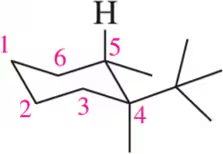
Given the following chair conformations, draw each in its planar form as if you were viewing it from above.
(b) Chair conformation diagram showing numbered carbon atoms and hydrogen for cis and trans isomer comparison.

Verified step by step guidance
1
Step 1: Understand the chair conformation. A chair conformation is a 3D representation of cyclohexane, where the carbon atoms alternate between being slightly above and below the plane. This minimizes steric strain and torsional strain.
Step 2: Identify the axial and equatorial positions. In a chair conformation, axial substituents point straight up or down (parallel to the vertical axis), while equatorial substituents extend outward (roughly perpendicular to the vertical axis). Locate these positions for each substituent on the given chair conformation.
Step 3: Translate the chair conformation into a planar form. To do this, draw a hexagon to represent the cyclohexane ring in a flat, top-down view. Place the substituents in their respective positions based on whether they are axial or equatorial in the chair conformation.
Step 4: Ensure correct stereochemistry. When drawing the planar form, use wedge bonds (solid triangles) to indicate substituents coming out of the plane toward the viewer, and dashed bonds (dotted lines) to indicate substituents going behind the plane.
Step 5: Double-check your drawing. Verify that the positions of the substituents in the planar form match the original chair conformation, maintaining the correct stereochemical relationships and avoiding errors in bond placement.

Verified video answer for a similar problem:

This video solution was recommended by our tutors as helpful for the problem above.
Video duration:
1m
Was this helpful?

Key Concepts

Here are the essential concepts you must grasp in order to answer the question correctly.

Chair Conformation

The chair conformation is a three-dimensional representation of cyclohexane that minimizes steric strain and torsional strain. It features alternating axial and equatorial bonds, allowing for more stable arrangements of substituents. Understanding this conformation is crucial for visualizing how substituents affect the molecule's overall stability and reactivity.
Recommended video:
Guided course
03:29
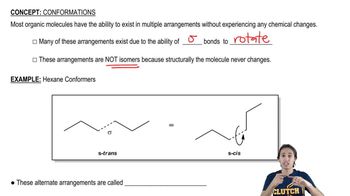
Understanding what a conformer is.

Planar Representation

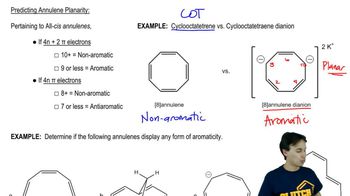
Planar representation refers to the two-dimensional depiction of a molecule, which simplifies the visualization of its structure. When converting a chair conformation to a planar form, it is essential to accurately represent the bond angles and distances to maintain the integrity of the molecular geometry. This representation helps in understanding the spatial arrangement of atoms and substituents.
Recommended video:
Guided course
06:47
Rules for Predicting Planarity

Axial and Equatorial Positions

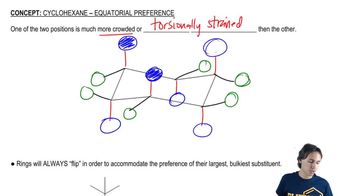
In the chair conformation of cyclohexane, substituents can occupy either axial or equatorial positions. Axial substituents are oriented perpendicular to the plane of the ring, while equatorial substituents are oriented parallel to the plane. The choice of position significantly influences steric interactions and the overall stability of the molecule, making it a key factor in conformational analysis.
Recommended video:
Guided course
04:02
Equatorial Preference